
Introduction
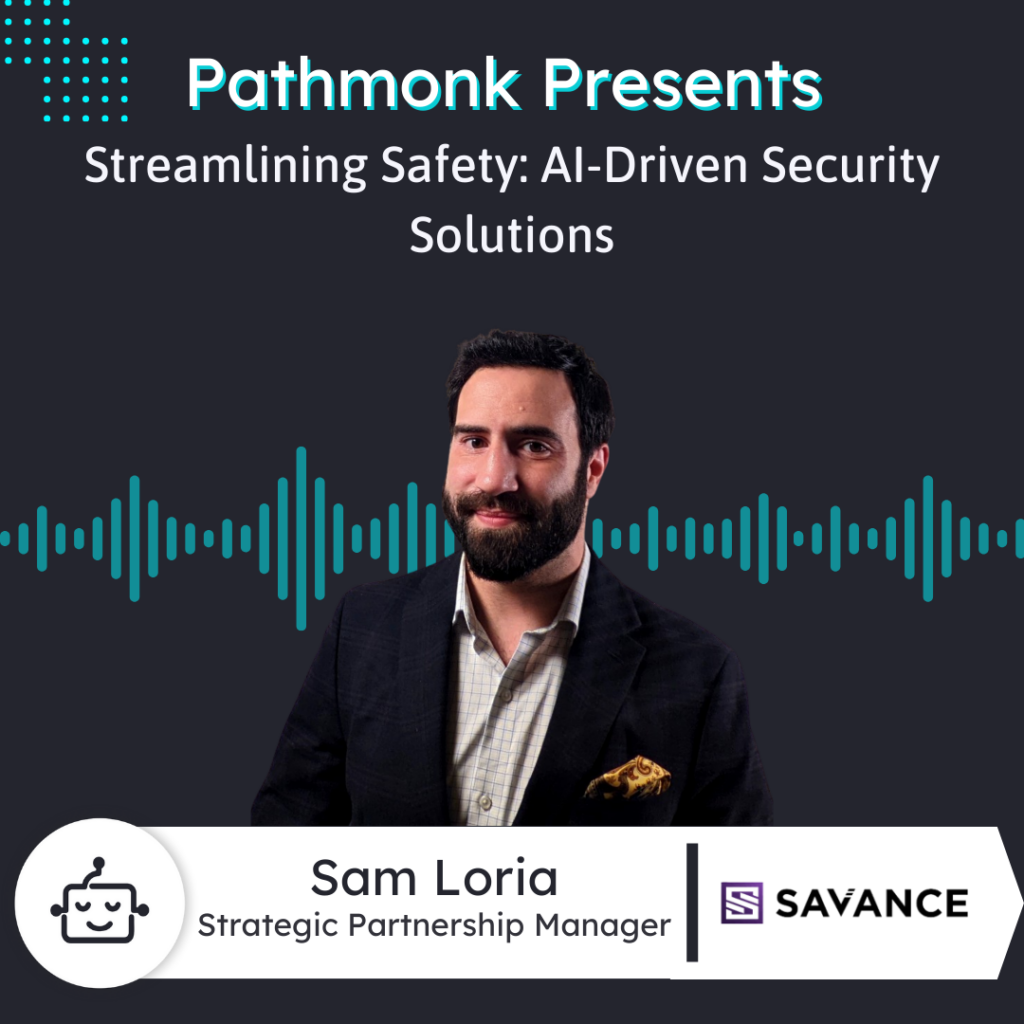
In this episode of Pathmonk Presents, we welcome Sam Loria, Strategic Partnership Manager at Savance. Sam introduces us to Savance’s innovative solutions for business safety, security, and accountability. He delves into how their software streamlines visitor management, emergency evacuations, and access control.
Sam shares insights on automating entrances, leveraging technology for cost-effective security, and the importance of real-time accountability during emergencies. He also discusses Savance’s multi-channel approach to customer acquisition, emphasizing the significance of partnerships and referrals in their growth strategy.


Increase +180% conversions from your website with AI
Get more conversions from your existing traffic by delivering personalized experiences in real time.
- Adapt your website to each visitor’s intent automatically
- Increase conversions without redesigns or dev work
- Turn anonymous traffic into revenue at scale
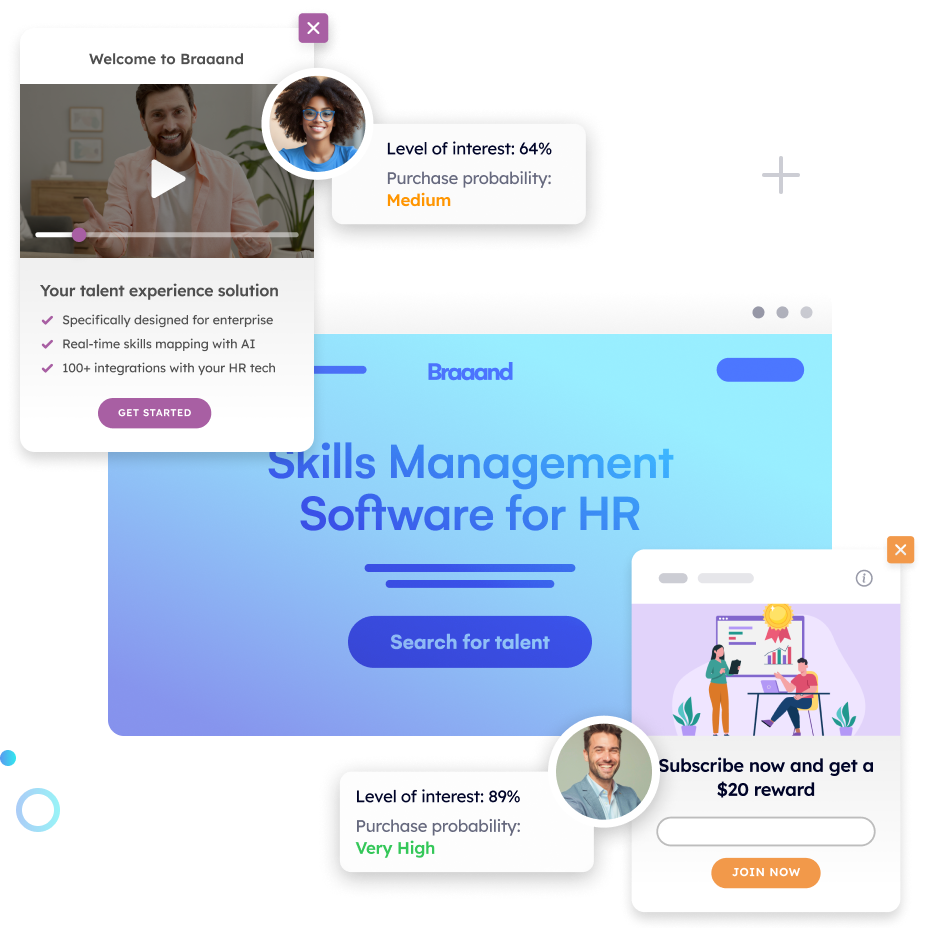
Ernesto: Pathmonk is the intelligent tool per website lead generation. With increasing online competition, over 98% of website visitors don’t convert. The ability to successfully show your value proposition and support visitors in their buying journey separates you from the competition online. Pathmonk M qualifies and converts leads on your website by figuring out, where they are in the buying journey and influencing them in key decision moments. With relevant micro experiences like case studies, intro videos and much more, stay relevant to your visitors and increase conversion by 50%. Add Pathmonk to your website in seconds. Let the AI do all the work and get x to 50% more qualified leads while you keep doing marketing and sales as usual. Check us on pathmonk.com Welcome to today’s episode. Let’s talk about today’s guest. We have Sam from Savance strategic partnership manager with them. how you doing today, sav?
Sam Loria: I’m doing great. How you doing over there?
Ernesto: I’m doing great. Thank you so much for asking. And I’m sure our listeners are tuning in and wondering what Savance is all about, so let’s kick it off with that Sam, in your own words, can you tell us a little bit more?
Sam Loria: Yeah. We’re all about providing essential solutions for businesses that ensure safety, security and accountability, right? So our solutions range from visitor management software to managing evacuations as emergencies happen, making sure that who’s on site can be accounted for, especially in instances where you’ve got fires, active shooters, incidents where whos entering the facility is important in terms of security to begin with.
Then if an incident does happen, it’s unfortunate a lot of times, but being prepared versus being reactive is always so important with a lot of the people we talk to. So we’re business to business. Obviously as partnership manager, director of marketing and sales, it’s all about relationships, partnerships who, you know, right now we’re able to leverage what’s in front of us to provide for the greater good here.
Ernesto: That’d be awesome to hear that from you. And so, Sam, so that way our listeners could get a good understanding of your company—what are some key problems that you saw for defines?
Sam Loria: Yeah, a lot of times it’s automating entrances, right? You’ve got security guards, you got people playing 21 questions at a front desk, issuing credentials, making sure people are granted access to the right parts of the facility. You have accountability of where they are.
Obviously from a security standpoint, it’s very important. From a cost benefit standpoint, it’s huge to leverage technology. Covid changed the game overnight. All of a sudden, you had to play 21 questions, play nurse at the front desk, take your temperature, all those things just to be sure that you were allowed to get in the facility, right.
So a lot of times we talked to people, you have high level employees that are pulled down, you know, 05:00 a.m. on a manufacturing floor, you know, to check off a bunch of boxes for compliance, you know, and then you got rotating casts, you know, of other workers you can backfill it with and essential operations can’t shut down.
Ernesto: Right.
Sam Loria: So for us, we can automate all that with technology, right. Ensure that everybody is going through whatever checks they got to to get into the facility. And then you have complete accountability of where everybody last was. You got fires, active shooters, all those incidents, send out mass notifications, integrate, you know, with the facility, with the life safety system, the access system. So you got a real time list of who’s in there quickly, account for everybody’s safety. Makes a huge difference in those moments when seconds count.
Ernesto: Yeah, would agree with that. So then is there a certain vertical or is there an ICP before? First of all?
Sam Loria: Yeah. So ICP is usually the ones that are most concerned with safety, security, accountability.
Ernesto: Right.
Sam Loria: So you’ve got, like everything from manufacturing and all the subcategories, you can go down, drill down into that, like food and beverage has a lot of really strict requirements. Aviation, transportation, going into the government vertically, you got everything from embassies and defense, military, local governments, going across healthcare, you got hospitals down to small outpatient facilities.
Really, any business has ultimately fit our ICP. But it’s mostly the ones where you’ve got immediate why nows. Or if there was a fire drill in your facility today, would you have people missing from your roster? Are you accounting for the person who took off for lunch? never told anybody. How about the visitor that came in to fix your plumbing? Nobody knows what that guy looks like. He’s just a name on a list. Maybe if you’re lucky.
So that kind of problem solving use case connection goes beyond product market fit for us. You got to get to the heart of those pain points and the problems and get them to say, oh, that’s why now, Preston.
Ernesto: All right. Awesome to hear that from you guys. How would they usually find out about you? Is there a pipeline acquisition channel where.
Sam Loria: Yeah, so we’re pretty multi channel. Obviously, partnerships is one of our biggest proactive focuses. Referrals have historically been huge for us, right? You get one local government gets to using the system, and it’s all the neighboring governments then pick it up, right? And it’s like small worlds a lot of the time.
So we had a lot of direct business to business referrals early on. Based on early successes, we’d leverage case studies to build up organic inbound demand. And then ultimately for us, we work through channels because our system relies—we can be standalone, but then we’re exponentially better when we’re integrating with the access control system, for example, and we can pick up on when somebody uses their badge at a door. That’s a much more frictionless and reliable indicator for us of who’s on site. We’re able to get additional functionality. Same thing with creating an unattended entrance or lobby.
So for us, partnerships is huge, and a lot of our partners will get requests for the problems we solve. And they know they can’t do it on their own, we can’t do it on our own, but together we are able to do it. So we get a lot of referrals through partners, integrators that are resellers, and then our partners that we integrate with ourselves. So that’s been huge.
And then obviously, the balance between inbound and outbound for us—we’re constantly creating content the best we can to tailor to our audience our ideal customer profile. We’re trying to identify, make sure we have good insight to intent, make sure that we’re able to get good visibility as to who’s consuming what content, where they are in their journey through the funnel. And we’re making sure we’re getting deals that are in our pipeline converted close, so we’re able to turn all of our marketing efforts into revenue as quick as possible.
Ernesto: That’s important. So that way our visitors, our listeners who are tuning in can visit you guys. You could always check them out at savance.com. What role does a website play?
Sam Loria: It’s huge. I mean, historically, we’ve been able to tailor content based on both specific target audiences for industries, for people within an organization, because you might have an early champion that’s a safety person, but they’re not the only person in the buying committee, especially when you’re talking big enterprise software solutions.
So for us, we’ve been able to leverage multiple websites over time to build up organic search traffic that finds us because we are what they’re looking for. And then we do a lot of advertising that’s pretty targeted towards our ideal customer. We do our best to segment our audience, make sure we’re creating content that’s going to convert, get that in front of them. Especially the farther we go with it, the more we’re able to get more direct—closer to the revenue—as possible.
Ernesto: Right.
Sam Loria: You got all these deals that are in the red zone in your pipeline. There’s only so much a sales team can do. Marketing has to provide their support to help grease the wheel, get them the content they need, the reinforcement, give them that trust, expertise, authority. That’s going to make them say, today’s the day.
Ernesto: Right, awesome to hear that from you. So then, based on that, is there any types of tools or methods that you would recommend to our listeners as far as some website lead generation?
Sam Loria: Yeah, I would say, I mean, first you’ve got to have systems in place that are manageable and scalable.
Ernesto: Right.
Sam Loria: Creating systems of accountability and visibility, like having a basic grasp on analytics and attribution, and having a clear pulse on who’s coming to your site. What was their source, where did they come from, what efforts are we doing? And then are we able to see and attribute those efforts and then how well are those connected to the revenue?
And a lot of times you’ll have siloed systems where you might track all of that, but then it’s not attributed to any of the deal or revenue data and you’re really just blindly guessing. Oh, on a hunch, this is worth investing marketing resources in. Having that data at your fingertips—making sure you have the right tools, the right systems—so everybody who comes to your site, if you have the ability to gain insight to who they are, connect the dots as much as possible, and then be able to leverage that… it gives you that leveraged ability to put your effort in the right place.
Ernesto: All right, awesome to hear that, Sam. Well, let’s switch gears a little bit and talk about you as a leader—what are some key tasks you focus on?
Sam Loria: Yeah. For me right now, a lot of it is alignment and building out the team, right? Absolutely. Marketing efforts—a lot of it is lead generation—but then a lot of it is brand, a lot of it is product, a lot of it is empowerment and enablement, especially when you’ve got partners and you’re enabling them to market and sell and implement and support and build your solutions better than we’re able to do ourselves is the end goal a lot of times.
Ernesto: Right.
Sam Loria: It forces us to be able to reflect inward and say, okay, how well are we able to build that out within our own team?
Ernesto: Right.
Sam Loria: And then the closer we can get to a fast tracked onboarding, ramp up certification development growth process, the more we’re able to scale out our business.
Ernesto: Right.
Sam Loria: And for us, it’s been balancing those two sides of bringing new partners in, making sure they have the tools and resources they need to be an extension of us and be better than we ever are at the things that we do, taking what we do best, combining it with what they do best. A lot of our partners are already working with our ideal customer, and they’ve got the cameras up on the ceiling, they’ve got the locks on the doors. Everybody’s identity is managed through them, and we’re a logical addition to them.
Ernesto: Right.
Sam Loria: So it’s a whole lot of empowering our partners and then building out the same resources and tools for our own team internally so we can scale out and fully realize our mission and vision.
Ernesto: Yeah, definitely. Great to hear that from you. Let’s switch to our next section here, Sam, which is our rapid fire question rounds. Are you ready for this?
Sam Loria: Cool.
Ernesto: All right, first off, Sam, what is the last book that you read?
Sam Loria: Man, I’ve been reading this. It’s called Wisdom of Saints. It’s honestly, it’s like all about, you are who you surround yourself with, right. People either pull you up or they pull you down.
Ernesto: Right.
Sam Loria: And it’s like, every day, it’s got like a little short quote from a saint that absolutely just opens up your eyes and keeps you in alignment in personal development moving forward. Today’s was hilarious, and it did be in the right spot. It was: you can’t be half a saint. It’s either you’re not a saint, or you’re entirely a saint.
Ernesto: Right.
Sam Loria: And it forces you to remember you’re always, always trying to stay on that Pathmonk. So that’s been a great book for me. That’s the one I’ve been—you know—probably an hour ago I read today’s. So that was awesome.
Ernesto: Awesome. And then, really curious, right now what is the company focused on at the moment?
Sam Loria: The most, yeah, we’re built around automation and a lot of the things that we provide—once they understand the reasoning behind it, they’re on board with it. But then technology isn’t 100% there yet.
It’s like, oh, you’re telling me I got to go to a kiosk to check myself in. You’re telling me a person’s got to check me in? Or you’re telling me I got to go to my computer and update my status or rely on this using my badge at the door?
So for us, it’s always been about automating and streamlining those processes to make it so that it’s pain free for everybody. And it’s entirely about safety and security. It’s got nothing about any of the negative connotations with it.
So for us, a big pinnacle has been facial recognition. You got cameras throughout facilities left and right, just like access is controlled at the reader level. For us, entirely just of knowing who’s in a building. We deal with so many refineries, and there are so many places where it’s like, if it was your family member that was working there and there was a fire in that building, you would want to know if they were inside and they were safe.
So for us, facial recognition is a big thing that we’ve been releasing. With return visitors especially—like hospitals—where you got people coming in to see their loved ones. Before, it was like you had to go to the concierge, you had to run through a check in at a kiosk. Now you can go through that initial check in process, and then you come back and it’s just walk in and your face is picked up.
And we’ve seen way more adoption than we thought. Public perception is still—we’re at early adopter stage—but you got big hospitals where it’s like, you give people the option, and 35% of them are taking it. I would have guessed maybe half as much. But it goes to show having good attributable data is so important.
Ernesto: All right, awesome. And Seth, if there would be no boundaries in technology, what would be that one thing that you want to fix for your role as a marketer?
Sam Loria: That I’d like to… what? One more time? I’m sorry.
Ernesto: I’ll start with the topic. If there would be no boundaries in technology, what would be that one thing that you want to add for your role?
Sam Loria: As a marketer today? Oh, that’s a great question. Attribution. I mean, at the end of the day, being able to personalize your content, your message for your audience in a way that doesn’t require so many hoops and hurdles and jumping through flaming rings.
And part of it is the pushback from really bad marketing and really bad advertising over time that just beat people down. Now the tools are getting stripped back. It’s getting harder and harder to deliver the right message to the people who need it at the right time.
Especially when you’re providing something that people are already looking for and you see the intent data to prove it. These people are clearly in the market. They’re clearly ready to buy, and they just haven’t found you.
So refining our efforts to connect with them, making sure we’re providing relevant messaging—we’re connecting with them and we’re providing them a service, not trying to just sell them something. We want to help them solve a problem they have, and we just happen to be the one that has the solution.
So for us, that’s huge. If we could automate and simplify that process and make sure that every advertising dollar was going towards putting the right message to the right person, every piece of content that we’re putting all of our resources into creating is getting in front of the right people at the right stage in their journey—that’s what I’d love to automate as much of that as possible.
Ernesto: All right, awesome. And next up, finally— you do have a lot of experience already in the marketing world, but what is one piece of advice that you would give yourself if you were to restart your journey as a marketer?
Sam Loria: Always, always keep everything back in alignment with strategy, your objective, and your key results.
Ernesto: Right.
Sam Loria: It’s so easy in the day to day sometimes to get a little bit of whiplash, you know, and you’ve got to constantly have your eyes on the road and you got to constantly be moving forward. And if you’re always just jumping at everything as it comes up, you got to be able to bring it back to the Pathmonk and make sure that every step you take is still moving in that forward direction.
A lot of campaigns, it’s like a B2B testing, and you might have an idea and you might be like, this is the right way to approach this. And then you go and you test that out, and it turns out your hunch wasn’t right. So instead of just sticking to your hunch and having no actual data or insight to back it: experimentation. And accepting that you’re going to fail, right?
Like, if you send outbound emails and you send 1000 of them, you’re going to be lucky to convert two or four of them in that day, right? If you’re lucky. And you could go days without converting a single one. Some people can go weeks without converting.
So it’s like you only have a limited pool and you only got so many shots. And you blow your chance, you miss your opportunity, you leave a wrong impression—those kinds of things can leave you dead in the water. So you absolutely have to be willing to experiment, have good attributable data behind everything you do, so you can make smart decisions and constantly evolve, move forward.
Ernesto: Definitely some great advice there from you, Sam. And we’re coming to the end of the show here, Sam, but before we do, I do want to give you the last word. If someone forgets everything about the interview today, what is that one thing they should remember about your company?
Sam Loria: Yeah. It’s that we’re solving problems. And I’d hope that everybody does the same and looks at their marketing journey the same way. How can I put myself in the other person’s shoes? And are my efforts something that if I was on the other end, I would be receptive to? Is this a benefit to me in the same way?
And that’s part of that is the partnership side of me, right? Where you need to be looking at everything from the other person’s point of view as much as possible, as much as yours, because the ultimate outcome is both of you getting something out of it and it being the most positive thing for both of you.
And that’s the beautiful thing about a partnership together. You’re way more than you ever could be on your own.
So for us, that’s absolutely paramount, as we solve problems for people. And I’d hope as everybody grows as a marketer, it’s: how can I put myself in the other person’s shoes and help them, right? You’re providing a service, you’re providing a product, you’re solving a problem for somebody. How can I shortcut that?
I’m sure you got to go through all the hoops and hurdles in the world to get it in place. You got to go through your cybersecurity team, you got to go through your finance team, you got to get executive team buy in. You got a 200 page paper on this and that and the other. And anything we can do to work together is, at the end of the day, the most important thing.
So the community, the culture—that’s what I was very excited about, you know, the invitation to jump on here with you guys, especially going through the list myself, the other people that you’ve talked to. So the more we can learn from each other, the more we can grow.
Sam Loria: I mean, to me at Savance, that’s like my hope, you know? Obviously, not everybody is our ideal customer. Not everybody is our ideal partner. Not everybody is going to be a part of Savance. But if we can have any positive impact or make a difference—if there’s anything we can learn from each other, benefit from mutually—we’re here. You know where to find us. Hunt me down, definitely.
Ernesto: For our listeners, you could always check them out at savance.com.
Sam Loria: Declutter your process.
Ernesto: Optimize oracle salmon for listeners. Thank you. And I’m looking forward to our next episode at Pathmonk Presents. Thanks a lot, Sam.
Sam Loria: Thank you.