
Introduction
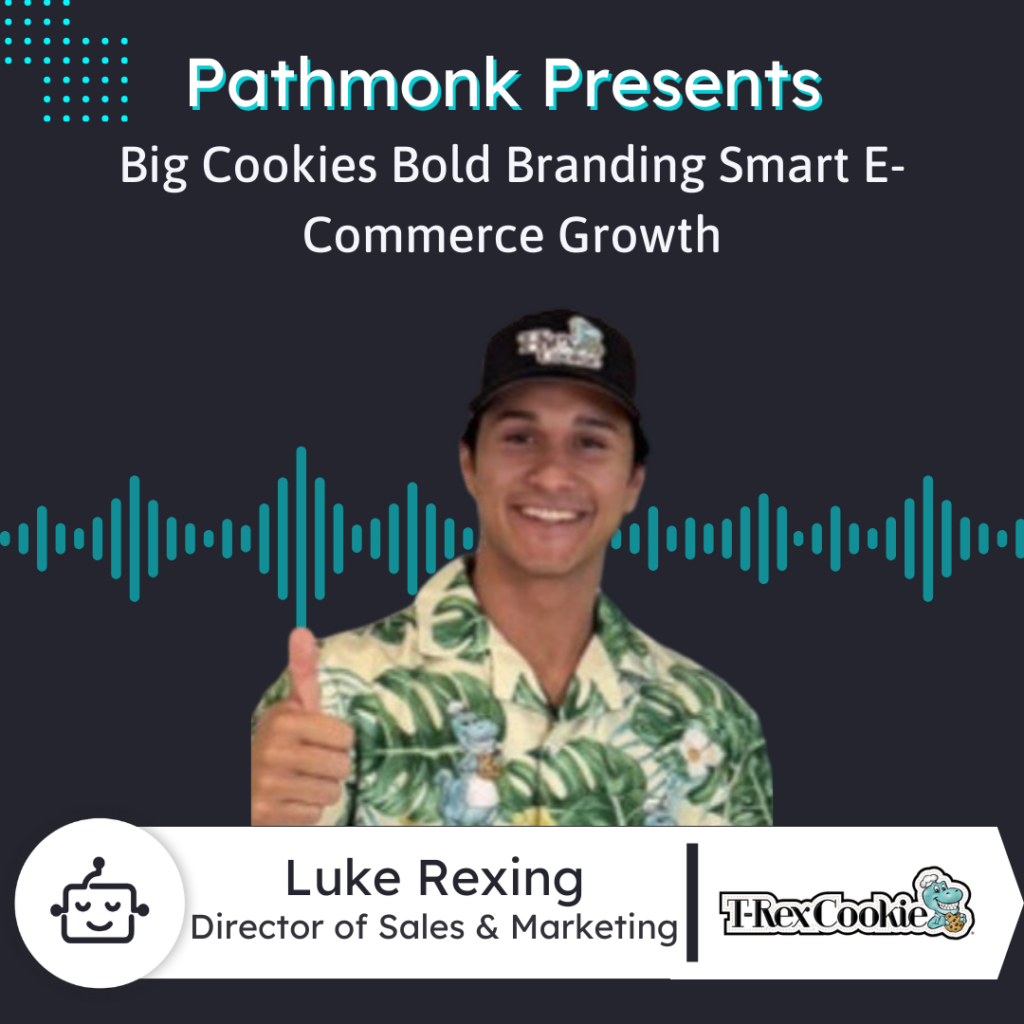
In this episode of Pathmonk Presents, Luke Rexing, Director of Sales and Marketing at T-Rex Cookie, shares how a family-founded brand is scaling through sharper positioning and smarter e-commerce decisions. Known for its half-pound and five-pound cookies, T-Rex Cookie is doubling down on corporate gifting as a high-impact growth channel.
Luke breaks down their transition to Shopify Plus, lessons learned from website conversion mistakes, and why clear calls to action and social proof drive sales. He also reveals how AI product photography and LinkedIn ads are shaping their B2B strategy. This conversation is packed with practical insights for founders navigating growth, branding, and digital optimization.


Increase +180% conversions from your website with AI
Get more conversions from your existing traffic by delivering personalized experiences in real time.
- Adapt your website to each visitor’s intent automatically
- Increase conversions without redesigns or dev work
- Turn anonymous traffic into revenue at scale
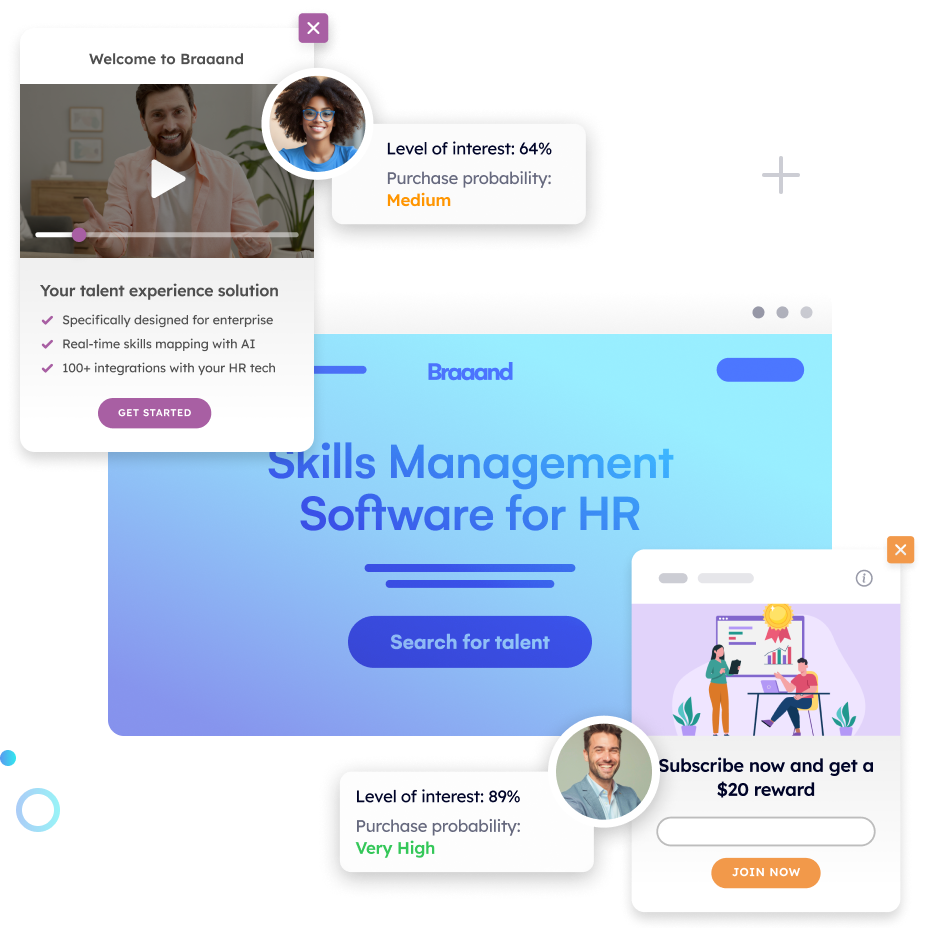
Rick: Pathmonk is the AI for website conversions. With increasing online competition, over 98% of website visitors don’t convert. The ability to successfully show your value proposition and support visitors in the buying journey separates you from the competition online. Pathmonk qualifies and convert leads on your website by figuring out where they are in the buying journey and influencing them in key decision moments with relevant micro experiences like case studies, int videos, and much more.
Stay relevant to your visitors and increase conversions by 50% by adding Pathmonk to your website in seconds and letting the AI do all the work and increase conversions while you keep doing marketing as usual. Check us out on Pathmonk.com.
Everybody, welcome back to Pathmonk Presents. Today we’re joined by Luke Rexing, the Director of Sales and Marketing at T-Rex Cookie. Luke, welcome to the show.
Luke Rexing: Good to be here. Thanks for having—
Rick: Me. All right. Good to have you, good to have you Luke. Maybe we start with the basics. What’s T-Rex Cookie and what you guys are all about? And if you were explaining this to a friend over a glass of milk even, how would you describe what you do?
Luke Rexing: Yeah, in short, we do big cookies. So this is our frozen dough here, and on the front of the package, that is the actual size—whoop—that is the actual size of our cookies. So each one is half a pound. We also do five-pound cookies. So our cookies are designed to be a shareable or memorable experience for people. So that’s what we do.
Rick: I guess that’s the T-Rex reference—something that’s good for a T-Rex.
Luke Rexing: Yeah. Yeah, exactly. The arms of a T-Rex are short, so the cookie has to be big.
Rick: I love it. That’s great branding, and it’s really cool. Memorable for sure.
Now, for a cookie it’s a bit of a given, but are there any types of customers that are the best fit for this cookie? I’m assuming people will love cookies, but when we get into the marketing technicality of it, who’s your ICP, what are you marketing to, and what can they get from you essentially?
Luke Rexing: That’s a great question. That’s actually something that we are working on right now—segmenting our customer base—because at T-Rex, we have about nine different channels of business that we are in. We do wholesale, we do grocery, we do concessions, markets, all these different channels, and there’s a little bit of a different avatar in each one.
So we are looking more internally and trying to figure out, okay, who is the best customer for us? And I think right now the answer to that is probably corporate gifting clients. Who we’re looking at to expand our business right now is people who probably work in HR or provide that gifting experience, either for a large corporate employee base or for a company’s clients.
We’re trying to send our cookies nationwide. So being a massive cookie, it does make for a great gift. And I think the customer journey for both sides—the buyer becomes the hero, and the person receiving the cookies gets free cookies—so it’s a win-win.
Rick: Yeah, I like that. It makes sense, going back to making it memorable. Corporate gifting sounds like an interesting avenue.
As far as online channels go, what do you say is the marketing channel that’s become your go-to for bringing in more attention and more business?
Luke Rexing: Great question. We’ll probably get into it a little bit later, but we’re switching our website over to Shopify. Our go-live date is in a little bit less than a month, so we’re gonna be figuring all of those things out.
But for targeting those corporate gifting clients, I think we want to look at LinkedIn—LinkedIn ads. That’s where these avatars reside. We’re gonna try that out.
But we also have Instagram and Facebook. We have pretty decent followings there, so we’re probably going to use Meta to run some ads, as well as Google. So we’re gonna take a shotgun approach to ads as soon as the website goes live and iterate from there.
Rick: The full gamut. Sounds good.
You mentioned you’re transitioning to Shopify. We’re a Shopify partner ourselves at Pathmonk. What’s the transition like at the moment? And how much of a role do you expect the website to play in bringing in new clients?
Luke Rexing: Great question. One of the reasons we’re switching over to Shopify is because our old website—WordPress and WooCommerce—was feeling a little outdated. We had customer feedback from our wholesale partners who order online saying it was a confusing ordering process. It got confusing both for wholesale and retail customers.
When I was doing research on what we should do to bring a more modern take to our brand, Shopify was clearly the play. And being that we also do B2B, we’re also gonna be on Shopify Plus.
The transition has been quite the journey. It’s been probably four months in the work now. We’re partnered with an agency that’s been helping us build out the website—Symmetry Commerce, shout out to them—they’ve been a great partner.
As far as my role goes, I’ve been making wireframes on Canva and creating the visual side of things. I was a marketing major in college, so the design aspect was my role. We’re transitioning everything over, with accounting on the backend and all these different processes. I’m really looking forward to the launch on Shopify here pretty soon.
Rick: Exciting times.
Drawing from that customer feedback that the old process was cumbersome: from your experience, what actually makes a website convert instead? Any favorite tools, tactics, frameworks? How do you make a website convert?
Luke Rexing: Great question. That’s the main reason why we’re switching over to Shopify.
I’ll give you a little insight into our old website: the main call to action—the main CTA button—on our website was “Our locations.” So clearly that’s not a converting website.
One of the main things, easiest tip: put a call to action that is a buy button—essentially “Order now”—and put that button above the fold. Meaning when someone lands on the homepage, they see that button without scrolling. Literally 100% of the people who land on that page are going to see a button that says Order Now, so there’s no way they can miss it.
On our old website, they had to scroll a little bit. It wasn’t clear where they could even order cookies, which is probably why they’re there.
Second: have CTAs throughout the website. In my research, I looked at competitors across industries and what they do differently. One of the main things is they just have call to actions everywhere—order now, click funnels that get people to order. Even on an “Our story” page, there are CTAs everywhere. To convert, you have to ask people to buy.
Another piece of advice: testimonials. Have great testimonials—ideally above the fold, or right beneath it—because people want to be validated in their purchase. The best way to convince people is to show them other people had a great experience. So testimonials and CTAs are huge.
Rick: Social proof, CTAs, clear language—that’s perfect. Basics.
Have you ever read Don’t Make Me Think by Steve Krug? Usability bible. That speaks exactly to that layout: you have a goal, make it obvious.
Luke Rexing: Yeah, exactly.
Rick: Maybe we talk about you a little bit. Give us a glimpse into your day. What’s a typical workday like, and what do you focus on day-to-day?
Luke Rexing: Funny you asked that. I was just teaching a class at my alma mater yesterday, and someone asked me what a typical day looks like. Honestly my answer was: there isn’t one.
We’re a small business—five full-time employees—so we wear multiple hats. Recently, my days have looked like taking product photos. I’ve been using AI a lot: I put together a little studio, set up cookies, take a photo on my iPhone, upload it to Gemini, create a prompt in ChatGPT for Gemini that says make this look super professional and website-ready, and have AI touch it up.
Last couple weeks have also been meetings with Symmetry Commerce, plus posting on social media, taking videos of cookies being made. There are deliveries to wholesale partners, so I’m on the road delivering cookies. And then there are days where I can sit back and do research: competitor websites, reading books, listening to podcasts.
Going forward, I’m trying to have a more structured schedule. Once the website goes live, I’d love to focus more on creating advertisements. But small business—there are always things that need to be done, fires that need to be put out.
Rick: Totally understandable. A lot of people relate to that—small or big companies. Different hats, different tasks, but you learn a ton.
Luke Rexing: Yeah. Experience and learning—developing skills—is what I want to do, which is why I chose to work for this company.
My mom founded this company about 10 years ago. Her name is Tina Rexing—hence T-Rex. That’s how the brand got its name. I’ve been aware of this company for almost half my life. Joining the family business, I made that decision knowing I probably won’t get paid as much as some peers, but I’m developing skills and learning so much, which is tremendously valuable.
Rick: I agree. Exposure to operations, family business—it’s invaluable.
We’re heading into the back half of the episode. Before we wrap up, we do a rapid fire segment. Just a few questions. Ready?
Luke Rexing: Let’s do it.
Rick: What’s the latest book you picked up, and any gems that stuck?
Luke Rexing: Two answers. One is Dune—fiction—just to get my mind off the day-to-day business. Sleep is very important, so winding down with fiction has been high ROI.
Second: I’m reading a book called Know What Matters by Ron Shaich, the founder of Panera. Super insightful—inside the mind of a CEO who started something from scratch, building it into something great, which is exactly the path I’d like to bring T-Rex on. Getting inside the mind of someone who’s done it before is the biggest value.
Rick: Love that. Any nonfiction besides that?
Luke Rexing: Yeah—100 Million Dollar Money Models by Alex Hormozi. I’m flipping through all three of his books right now: Money Models, Offers, and Leads. His content is phenomenal. I’ve been pushing my mom to consume more of his content around scaling.
In April this year, we’re going to his workshop in Vegas. Two-day workshop—finding the main constraint of the business and helping us take it to the next level. I’m really excited.
Rick: Nice. Maybe another episode for learnings.
If you had a magic wand and could fix one frustrating thing in your marketing life with tech, what would it be?
Luke Rexing: An extension of AI: using AI to create product photos. It hallucinates quite a bit, so there’s a lot of tweaking. If I could have it create exactly what’s in my mind on the first go every time, that would save me hours every day. Instant perfect execution of AI product photos and video—hopefully in the next five years we get there.
Rick: Good one. The rate AI is progressing, it’s plausible sooner.
What’s one repetitive task you’d put on autopilot forever?
Luke Rexing: Social media content—organic content. Taking photos, taking videos, editing, posting, captioning, responding to comments… it takes so much time. Extremely valuable, but repetitive. You hope something goes viral. I wish it could be fully automated while remaining authentic.
Rick: That’s the challenge—staying authentic.
Luke, thanks for being on the show. Last word: if someone forgets everything, what should they remember about the work you’re doing at T-Rex Cookie?
Luke Rexing: Keep an eye out for us in the future. If you’re a corporate client looking to gift some cookies, send us an email—you can find it on our new website hopefully in about a month.
But largely, 2026 is going to be a year of learning for us. What I want to bring to our culture is always learning, always iterating, and being okay with making mistakes—as long as we learn from them. If we have the right inputs, hopefully that helps us get to a nationally recognized company someday.
Rick: That’d be amazing. And if corporate clients want to check you out, where can they go?
Luke Rexing: They can check out t-rexcookie.com. There should be a menu on the side with corporate gifting. Otherwise you can reach out to me directly: luke@t-rexcookie.com. Just send me an email and we can figure something out.
Rick: Amazing. Luke, thanks again for your insights. Great conversation—have a wonderful day ahead.
Luke Rexing: Thank you, Rick. It’s been a blast.
Rick: Bye everyone.