Introduction
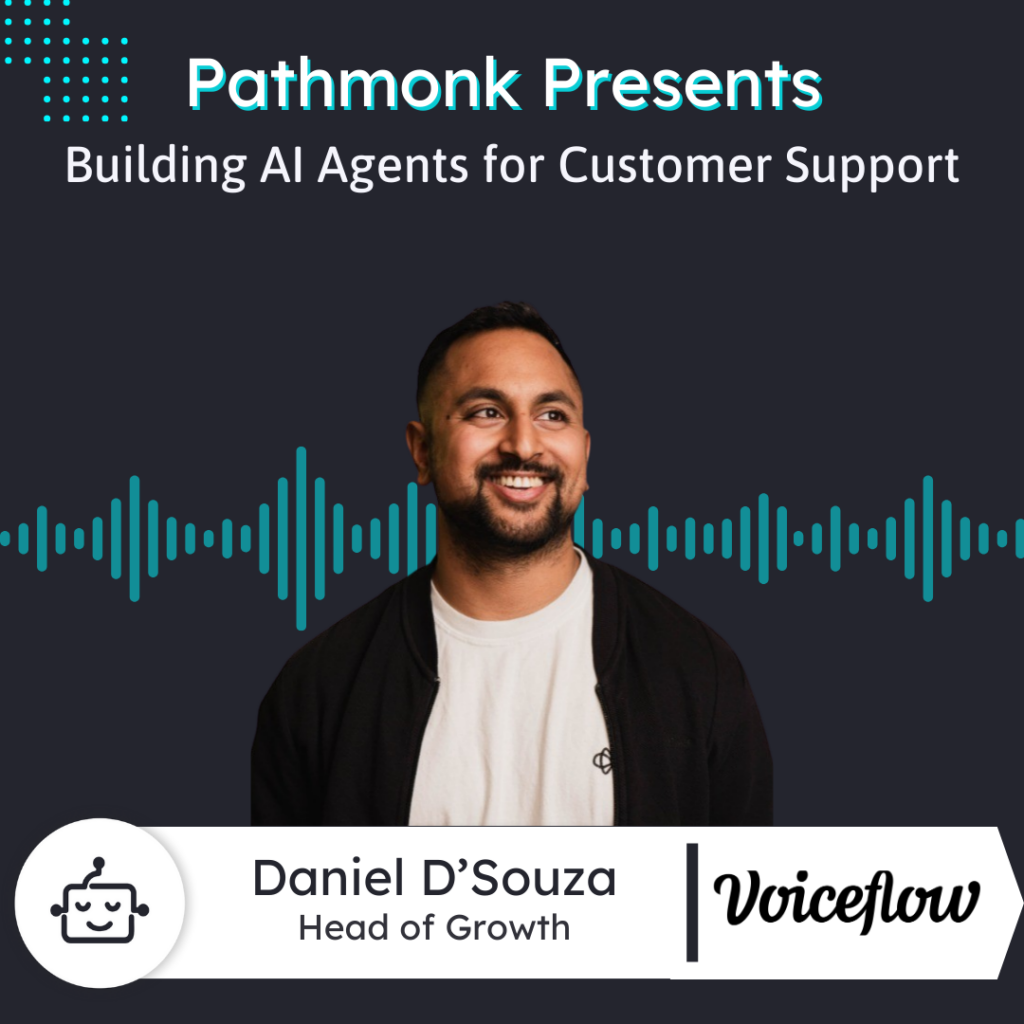
Meet Daniel D’Souza, Head of Growth at VoiceFlow, a leading platform for building AI-powered customer support agents.
Daniel shares how VoiceFlow helps businesses automate support tickets, personalize customer interactions, and improve response times with generative AI.
He also discusses the importance of community building, content marketing, and YouTube as a key channel for customer acquisition in the evolving tech landscape.


Increase +180% conversions from your website with AI
Get more conversions from your existing traffic by delivering personalized experiences in real time.
- Adapt your website to each visitor’s intent automatically
- Increase conversions without redesigns or dev work
- Turn anonymous traffic into revenue at scale
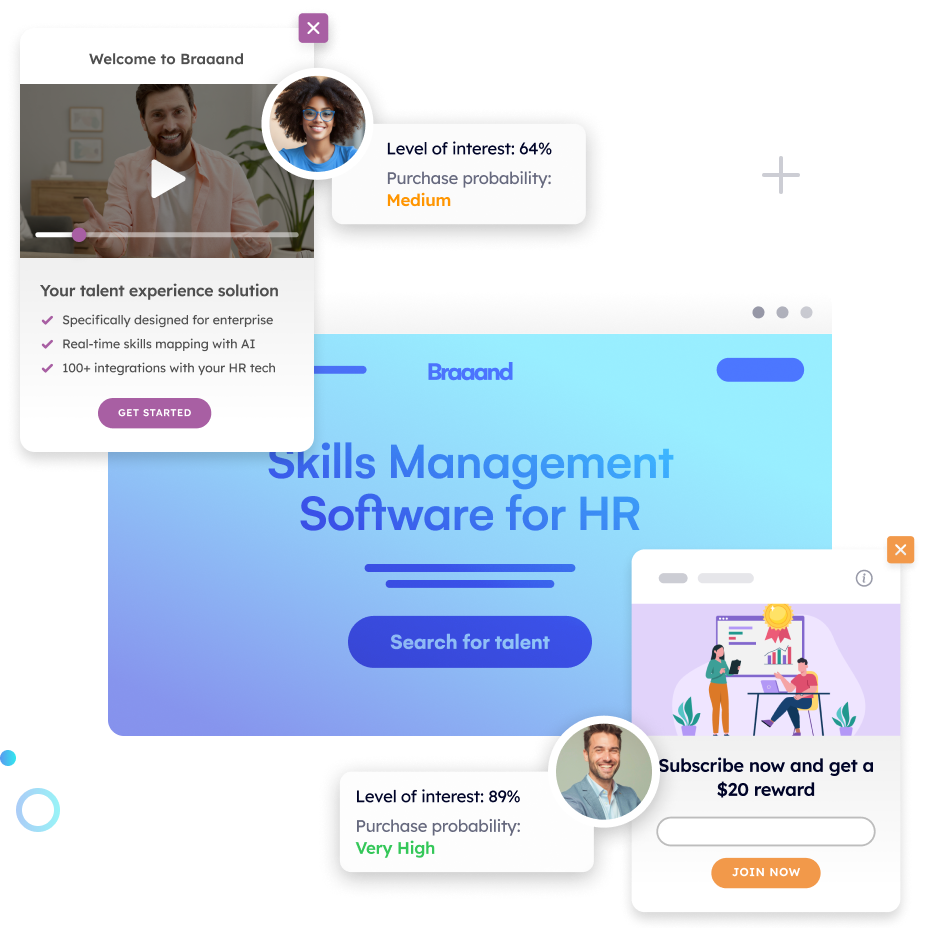
Ernesto: Pathmonk is the intelligent tool for website lead generation. With increasing online competition, over 98 percent of website visitors don’t convert. The ability to successfully show your value proposition and support visitors in their buying journey separates you from the competition online. Pathmonk qualifies and converts leads on your website by figuring out where they are in the buying journey and influencing them in key decision moments with relevant micro experiences like case studies, intro videos, and much more.
Stay relevant to your visitors and increase conversions by 50%. Add Pathmonk to your website in seconds. Let the AI do all the work and get extra 50 percent more qualified leads while you keep doing marketing and sales as usual. Check us on Pathmonk.com.
Welcome to today’s episode. Let’s talk about today’s guest. We have Daniel from VoiceFlow, head of growth with them. How are you doing today, Daniel?
Daniel D’Souza: Pretty good. How are you, Ernesto?
Ernesto: Great. Is it alright if I call you Tuba?
Daniel D’Souza: Yeah, go for it. It’s actually been my nickname for a year — oh my God, 20 plus years now. Since I was like in the fifth grade, basically, it became my nickname and then it just stuck with me ever all that time. I just kept it.
Ernesto: Definitely. All right. Perfect. It’s good to have you on today’s show. Really excited to learn a little bit more about VoiceFlow. We were talking about it before the episode, but let’s give our listeners what they came for. In your own words, can you tell us a little bit more about what it’s all about?
Daniel D’Souza: Yeah, so VoiceFlow is a software to build AI customer support agents, and specifically focused on medium to high complexity.
So if you need something that interacts with your internal services — let’s say you’re a bank — customers interacting with your chatbot or assistant, you want to be able to pull what accounts they have, what plan types they’re on, etc., and based on that provide them a really personalized experience.
When they’re asking questions, being able to hit up your knowledge base, use generative AI, and then combine it with information about them to answer their questions with a pretty high degree of accuracy.
We’re used by JP Morgan, Home Depot, BMW, about 10 percent of the Fortune 100. And over just the past year, things have been pretty nuts with the rise of generative AI.
We’ve been in this space for about five years, so we already had a solid foundation. And then when ChatGPT took the world by storm, it allowed us to accelerate things on our roadmap and provide probably the best AI agent building experience for medium to high complexity teams out there.
Ernesto: That’s awesome to hear — especially being part of the Fortune 500s, having a couple of those in your belt. But so our listeners could get a good understanding: what key problems do you solve for clients, Danny?
Daniel D’Souza: Customers use VoiceFlow for a variety of use cases, but the number one has been customer support.
Today customers expect a really personalized support experience. Before, it was about getting them to an agent or answering basic questions. Now we’re finding some AI responses customers get are even better than what agents provide — more personalized and faster.
For some customers, especially large ones using VoiceFlow as their production assistant for customer support, they’re seeing tickets automated by as high as 80 to 90% in some cases.
That’s the core use case: automating support and repetitive inbound requests.
Use case number two is internal tooling, and also lead qualification.
With VoiceFlow, you build your assistant on a collaborative canvas, upload documentation, connect Zendesk, whatever it might be.
Then you can use our API to connect to any channel. We have an out-of-the-box web chat, but customers also use our API to interact natively on their website, hook into Instagram DMs, hook into email, etc.
So you can send an email to a company and get a fully automated personalized response back powered by VoiceFlow.
Customer support is the primary use case, but we’re seeing it across a bunch of verticals now too.
Ernesto: Great to hear. You mentioned a couple of clients — is there a specific vertical niche segment you focus on?
Daniel D’Souza: I’d say financial services. Banks and customer support there is bread and butter.
They hit the criteria of mid to high complexity because there are logic checks happening in the background: who is this customer, are they pre-approved, can you talk about this thing, etc.
You also need to include account information which can be wide ranging. So that’s our sweet spot.
Next is telecom — very similar. Customers are highly personalized, you need to be regulated in how you talk to them.
Having fine-tuned control over what information you use, what you send to a large language model, what you send back, and making sure it’s accurate is crucial.
That’s where VoiceFlow fits in — especially with companies that have a team dedicated to this. On the front end it’s a collaborative design platform like Figma, and on the back end it’s powerful APIs.
So a non-technical team can build the assistant, then engineering can hook it into their custom stack.
Ernesto: Awesome. What’s typically the top client acquisition channel for you guys? Has it changed over the years?
Daniel D’Souza: Traditionally, LinkedIn was our primary channel. But over this last year, it shifted heavily to YouTube.
We’ve always focused on really high quality content around conversation design and building AI systems. Conversation design was the term before generative AI.
We built a reputation from LinkedIn content — designers and companies consider us the gold standard.
With generative AI, the target market expanded from purely enterprise to mid-market and SMBs, because what used to take a team months can now be done by one person in 10 minutes.
That brought in SMBs, mid-market companies, and agencies serving them.
That’s where YouTube took off. Before, our YouTube was mostly tutorials — bottom-of-funnel “how to use VoiceFlow” content.
This year, once we saw the SMB/mid-market wave, we built a community on Discord. After people got activated, they started creating content too.
A lot of agencies added AI agents as a service, and they started making YouTube content. That created a flywheel: we create content, it activates people, they join the community, learn, then create more content.
Before, searching “VoiceFlow” on YouTube was just our channel. Now there are more community videos than ours.
Influencers noticed, we did partnerships, and now YouTube accounts for about 60 to 70 percent of our signups over the last year.
It 5X’d our self-serve revenue, and we’re leaning hard into it.
The audience is also deeper in the funnel because they’ve watched hours of videos. So instead of needing a demo to understand, they go to the site, grab a template, sign up, and jump in.
It started with SMB and mid-market, but now it’s pervasive — we’re getting enterprise leads from YouTube too, and expansions in big accounts because teams discover us there.
Ernesto: Definitely. People learning from other people — that’s a goldmine. Let’s switch gears and talk about you as a leader. As head of growth, what tasks do you focus on day to day?
Daniel D’Souza: Two core metrics: acquisition and activation.
Acquisition is getting new customers — especially self-serve SMB/mid-market — but also generating product-qualified leads for enterprise.
Activation is getting someone from signup to launching a production assistant as fast as possible.
On acquisition, it’s really about content. I have a tight loop: I talk to new users that hit certain criteria. After enough calls, you see trends: where they come from, what they care about, what problems they face — then we create content, rinse and repeat.
We have triggers: based on enrichment data and actions in the tool — did they drag an API step, hit 500 interactions, etc. — I get emails, meetings booked, dropped into my calendar. I talk to about one or two people a day.
That gives me a pulse on where people find us, what they’re building, which ones match ICP, and what content to create next.
On activation, it’s the same thing: what’s blocking you, what are you trying to build that you can’t yet?
I work with an engineering team on growth — I’m the PM for that team. We define requirements, build, release, and repeat.
Ernesto: Definitely a full plate. Let’s jump into rapid fire. Ready?
Daniel D’Souza: Yeah.
Ernesto: First off, what’s the last book you read?
Daniel D’Souza: I read a lot of fiction and history — it’s an escape and helps me think creatively. The last one was called Herc.
It’s the tale of Hercules, but it’s written from the perspectives of the other people in his life — the side characters — showing different sides of him, not just the hero.
If I tie that in: you’re not the only main character — many people interact with you. As a marketing leader, it’s your job to understand those perspectives and how to improve.
Ernesto: Great book. What’s one single thing your company is focused on the most right now?
Daniel D’Souza: Getting up to parity with leading generative AI tools.
Generative AI changed expectations for what an AI agent should be. We’ve always been top 1 percent on the collaborative design canvas — like the Figma for conversation design.
Now production has become a huge focus — more people are shipping to production and doing high volume.
So we’re figuring out what we must be top 1 percent at, and what’s okay to be top 5 percent at, because there are many pieces: developer extensibility, knowledge base, etc.
It’s about building the next generation tool for building AI agents.
Ernesto: If there were no boundaries in technology, what’s one thing you’d want fixed for your role as a marketer?
Daniel D’Souza: Better tracking.
In a post-cookie world, uniting all the pieces is hard. We have tons of content out there, and I’m learning where people come from through conversations, but I’d love a more objective source.
Even with tools like Segment, it’s hard to unite data and track where people come from before they’re on your website — privacy is good, but it makes attribution harder.
So I’d want easier tracking to see the full 360 journey, before/during/after the website.
Ernesto: Perfect. If there’s one repetitive task you could automate, what would it be?
Daniel D’Souza: Discord synthesis.
We started a Discord community earlier this year. It began small, now it’s over 6,000 people. It’s super active.
We built our own AI assistant in Discord that answers FAQs from our knowledge base, which helped a lot.
I’d love to take it further: identify people from ideal companies, asking great questions — and create a more catered experience, like I do in the product.
Discord is the wild west — there’s noise — and we’re figuring out how to make it more useful for everyone.
Ernesto: That’s a great way to tackle it — and using Discord like that is interesting. Great to hear.
Daniel D’Souza: It was surprisingly good for us. It started as an experiment because one of the big problems was making activation easier.
Before being head of growth, I led enterprise customer success, so I understood the journey: learning VoiceFlow, getting activated, inviting team members, pushing to production.
Enterprise customers we can be handholdy, but we needed a faster way to help everyone.
It goes back to the Photoshop analogy: if you get dropped into Photoshop, it’s confusing — but YouTube videos help. Discord was a way to help people quickly.
Then it took off. I’d recommend thinking about what’s a natural community for your product — it should feel organic.
It’s been a game changer: activation improved, and customers say they choose VoiceFlow because of the community.
Now the community builds on our APIs, builds plugins — it’s become a moat for us.
Ernesto: Lastly, Daniel: what’s one piece of advice you’d give yourself if you restarted your journey as a marketer today?
Daniel D’Souza: The role comes in waves. You start trying to solve a problem, you don’t know what to do — trough of despair. Then you find a trend, take advantage, it works, it gets out of control, then dies off, and you’re back in the trough.
I used to freak out in those troughs.
Now, whenever I’m in doubt, I book as many customer calls as possible. I ask: how’d you hear about us, what are you building, what’s your dream world, what’s stopping you?
That keeps my finger on the pulse and guides the way.
We waste too much time brainstorming creative growth ideas and not enough time talking to customers. Our biggest wins came from simple things: talk to a customer, learn about a person or channel, form a partnership, boom — new growth channel.
So when in doubt: talk to users, find the lowest hanging fruit, do that, repeat.
Ernesto: That’s great advice. Tuba, thanks for being on the show. Last word: if someone forgets everything, what should they remember about VoiceFlow?
Daniel D’Souza: If you’re looking to build an AI assistant — automate support tickets, inbound leads, anything like that — check out VoiceFlow.
Search VoiceFlow on YouTube or Google, you’ll see tons of info about how customers use it. When in doubt, check out the website, voiceflow.com.
And reach out to me if you have questions — LinkedIn or Twitter, I’m pretty responsive.
Ernesto: Daniel, thank you so much for being on. To our listeners, thank you so much for tuning in and looking forward to our next episode at Pathmonk Presents.