Are exit-intent popups still effective or outdated? Exit-intent popups are not completely outdated, but they’re no longer effective by default. They can still drive incremental conversions by catching users at the moment they’re about to leave, making them useful for lead capture, cart recovery, or last-chance offers. However, user fatigue, poor mobile detection, and overly aggressive triggers have reduced their baseline impact compared to a few years ago.
Today, exit-intent popups only work when they’re highly relevant, well-timed, and respectful of UX. Generic messages convert poorly; intent-aware offers, delayed triggers, clean design, and proper testing are what make the difference. In short: still a valid CRO tactic, but only when used strategically, not as a plug-and-play growth hack.
Table of Contents
Exit-intent popups have been around for a long time. At some point, almost every marketing team has tested them, removed them, brought them back, or debated whether they still make sense.
The real question isn’t whether exit-intent popups are effective or completely outdated. Some still work. The more useful question is when they work, and why so many implementations feel ineffective or even disruptive today.
Modern websites attract very different types of visitors, each with a different level of user intent. Treating every exit as a last chance to show the same popup message ignores how people actually browse and make decisions. In this article, we’ll look at when exit-intent popups still add value, when they fail, and how intent-based experiences have changed what “effective” really means.
Why did exit-intent popups become so popular?
When exit-intent popups first appeared, they felt genuinely refreshing. Websites didn’t interrupt users very often, and certainly not at the exact moment someone was about to leave. That alone made them effective and generated a wow effect among visitors.
The original problem they aimed to solve was simple: visitors were leaving without converting, and there was no clear way to react to that moment. Exit intent introduced a way to surface one last message right before abandonment, whether that was a discount, a reminder, or an alternative action.
At the time, this was powerful because it broke the normal browsing flow. An exit popup grabbed attention precisely because users weren’t used to being stopped. Even generic messages performed well, not because they were perfectly timed or personalized, but because they were unexpected.

Early CRO efforts benefited from this effect. Teams could add a single intervention and see measurable lifts without rethinking their overall experience. The promise was appealing: recover otherwise lost conversions with minimal effort.
The problem is that this effectiveness was driven largely by novelty. As exit-intent popups became widespread, users learned to ignore them, close them automatically, or feel interrupted rather than helped. What worked as a surprise mechanism doesn’t work the same way once it becomes a standard pattern.
Get your website’s conversion score in minutes
- Instant CRO performance score
- Friction and intent issues detected automatically
- Free report with clear next steps
So, are exit-intent popups still effective? Let’s look at the numbers
The data shows that popups as a format still deliver measurable conversion value, but the impact varies widely depending on how they are used.
Across a large set of campaigns, popups convert on average around 3.5 % to 4.6 % of visitors who see them, even without context-specific triggers, and top-performing popup campaigns can convert significantly more when the offer and timing are right.
When you narrow the focus to exit-intent popups, research suggests they can boost conversions by capturing visitors who were about to leave. According to recent findings, exit-intent popups have been shown to increase conversion rates by 10 % to 30 % compared to pages without them.
These figures tell us two things:
- Exit-intent popups still generate incremental conversions in many situations, especially when the message has clear relevance to the visitor.
- The lift is typically modest and contextual rather than dramatic, and effectiveness depends heavily on offer relevance, timing, and placement.
In other words, exit-intent popups are not inherently outdated. They can be effective, but they are a secondary tactic, not a core optimization strategy on their own.
In 2026, we know exit intent is not really intent
An exit-intent signal only tells you that a visitor is about to leave the page. It doesn’t tell you why.
Someone might be leaving because they found what they needed, because they’re confused, because they’re not ready yet, or simply because they got distracted. Treating all exits as the same moment of urgency is where most exit-intent popups go wrong.
This is why exit intent on its own is a weak signal. It reacts to a single action, cursor movement or scroll behavior, without considering what happened before. A visitor who skimmed one paragraph is treated the same as someone who compared features, checked pricing, and spent several minutes evaluating the offer.
That difference matters.
User intent is shaped by behavior over time. Pages visited, content consumed, interactions made, and time spent all provide context about whether someone is exploring, comparing, or close to a decision. Exit intent ignores that context and fires at the last possible moment, often with a generic message that doesn’t match the visitor’s state of mind.
This is why many exit popups feel intrusive rather than helpful. They don’t respond to intent. They interrupt it.
Effective use of exit intent today starts earlier. It looks at what the visitor was trying to do before leaving and adapts the message accordingly. Without that context, exit-intent popups are just guesses triggered by timing, not relevance.
Turn website traffic into sales-ready leads
- Identify high-intent visitors automatically
- Qualify leads before they reach your sales team
- Convert traffic without adding friction or forms
How behavioral intent, not just exit, should work
Exit intent still has a role, but not as a last-second reaction. Used well, it becomes part of a broader, intent-aware experience, not a standalone trigger.
Instead of reacting only when someone is about to leave, effective exit intent today starts by understanding readiness. The most useful signals appear long before the cursor moves toward the browser bar. Pages visited, depth of engagement, repeated interactions, and time spent on key sections all provide context about what the visitor is trying to do.
These signals matter more than cursor movement because they reflect intent over time, not just intent in a single moment. A visitor who explored pricing, checked FAQs, and returned to a solution page is sending a very different signal than someone who skimmed the hero section and left.
When intent is understood, the role of exit intent changes. It’s no longer about stopping someone from leaving at all costs. It’s about offering the right next step based on how ready they are.
For example:
- A high-intent visitor who explored pricing or product details may benefit from a customer testimonial, a short proof point, or a direct path to book a demo or start a trial.
- A visitor in evaluation mode may respond better to a short video, comparison, or explanation that helps them confirm whether the solution fits their needs.
- A low-intent or exploratory visitor is often better served with a softer option, such as an ebook, guide, or webinar, rather than a sales-driven CTA.
In this setup, exit intent becomes a timing layer, not the decision-maker. It helps surface an intervention at the right moment, but only after intent has already shaped what that intervention should be.
That’s the shift. From reactive popups that guess, to intent-aware interventions that respond.
How Pathmonk detects intent and adapts the website experience
Pathmonk starts from a simple premise: to understand behavioral intent, you need to recognize visitors reliably and observe how their behavior evolves over time.
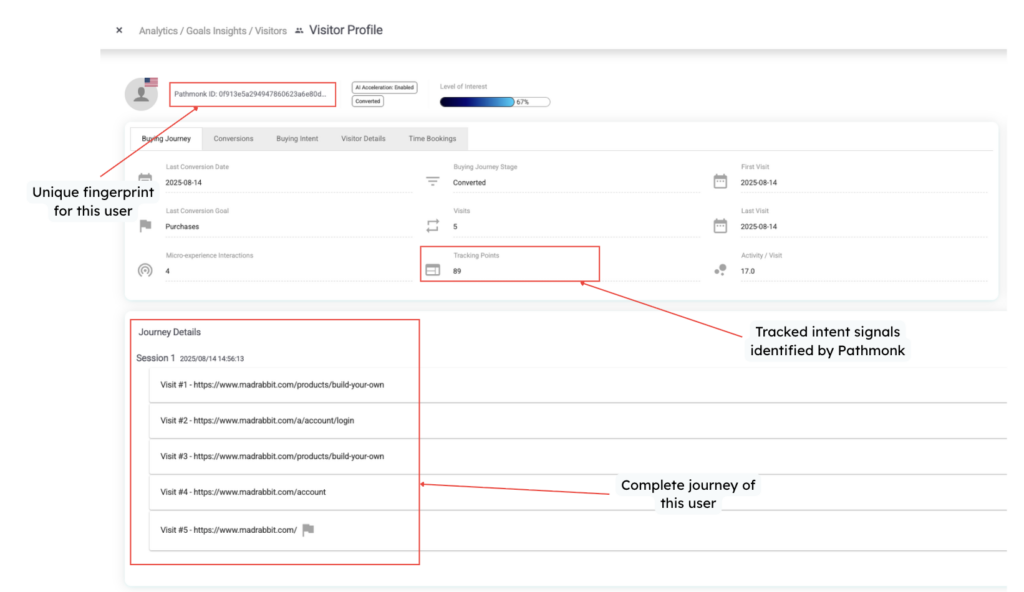
To do this, Pathmonk uses a proprietary fingerprinting technology that identifies each visitor who lands on the website without relying on cookies or personal data. Every visit is assigned a unique, anonymous identifier, which allows Pathmonk to recognize returning visitors, connect their interactions across sessions, and build a consistent view of how they behave.
This identifier is based on a vectorial fingerprint. Instead of storing personal information, Pathmonk combines non-sensitive technical signals from the browser environment, such as device type, operating system, screen resolution, and time zone, into a structured numerical vector. That vector represents a behavioral signature, not an individual.
Because this fingerprint is stable and privacy-safe, Pathmonk can track how a visitor moves through the site, even when cookies are blocked or consent is rejected. This is what makes it possible to analyze behavior accurately and in real time.
Once a visitor is identified, Pathmonk focuses on what they do, not just where they came from. The system observes pages visited, depth of interaction, scrolling, clicks, time spent, and repeated visits. These signals are continuously evaluated by Pathmonk’s AI to detect buying intent patterns.
Based on this behavior, each visitor is automatically assigned a journey stage, from Awareness to Consideration to Decision. This classification is dynamic. As a visitor explores more content, revisits key pages, or interacts with high-intent elements, their stage updates automatically. No manual rules are required.
This is where prediction comes in.
Using accumulated behavioral data, Pathmonk estimates the visitor’s most likely next step. Are they still trying to understand the problem. Are they comparing options. Are they hesitating right before taking action. That prediction determines what the visitor sees next.
Instead of showing a generic popup or reacting only at the moment of exit, Pathmonk displays a personalized microexperience aligned with the visitor’s readiness:
- Visitors in early exploration may see educational content that helps them understand their options.
- Visitors in evaluation may see short videos or explanations that clarify value and differentiation.
- Visitors close to a decision may see proof-focused elements like testimonials or a clear path to conversion.
Because identification, intent detection, and personalization all happen in real time, the website adapts continuously as behavior changes. The goal is not to prevent exits at any cost, but to respond intelligently to what the visitor’s behavior suggests they need next.
How adapting the experience to intent increased qualified leads by 87% for education platform Ausbildung-Weiterbildung
Ausbildung-Weiterbildung.ch used Pathmonk to reduce decision fatigue on a high-traffic education platform where visitors often struggled to take the first step, despite strong intent to find a course.
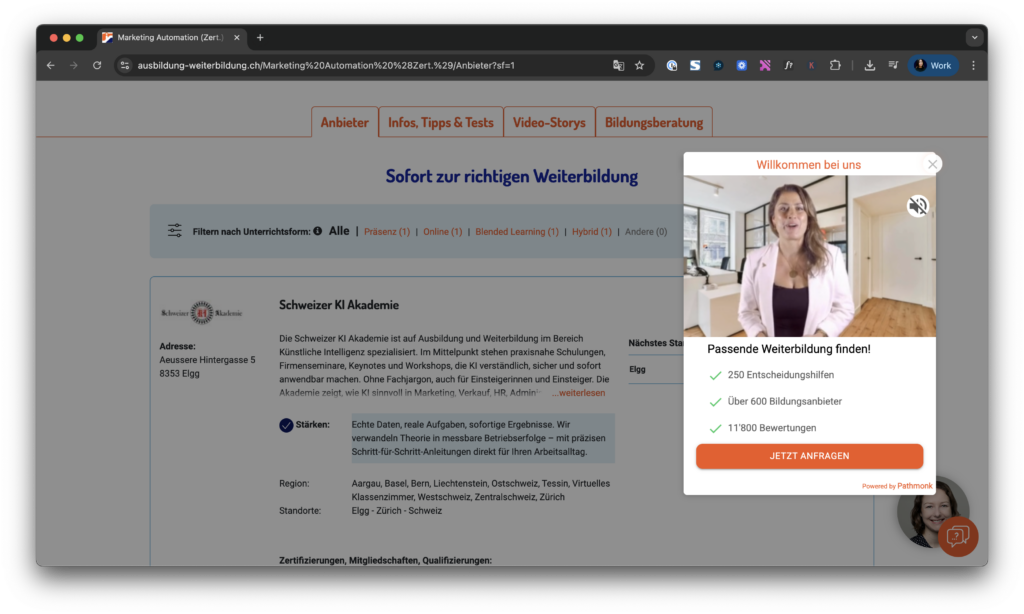
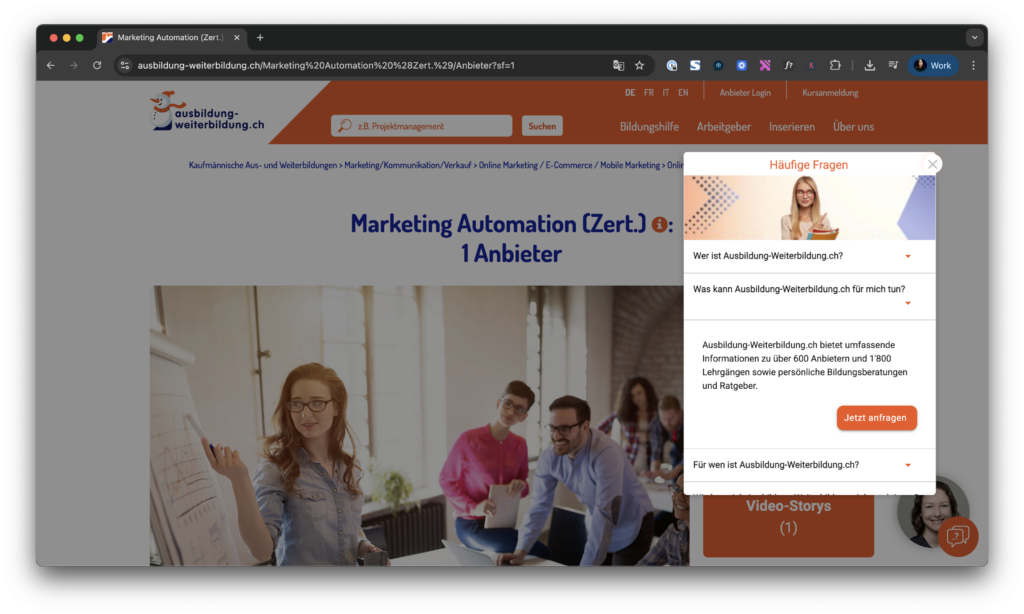
Pathmonk analyzed behavioral intent in real time, looking at how visitors navigated categories, how long they explored programs, and how close they were to starting an enquiry. Based on these signals, Pathmonk displayed different microexperiences that matched the visitor’s readiness.
Some visitors saw explanatory prompts that helped them understand what to do next. Others, showing stronger intent, saw a more direct call to action. In all cases, the CTA was consistent and led to the same next step: starting a real course request within the category they were already browsing.
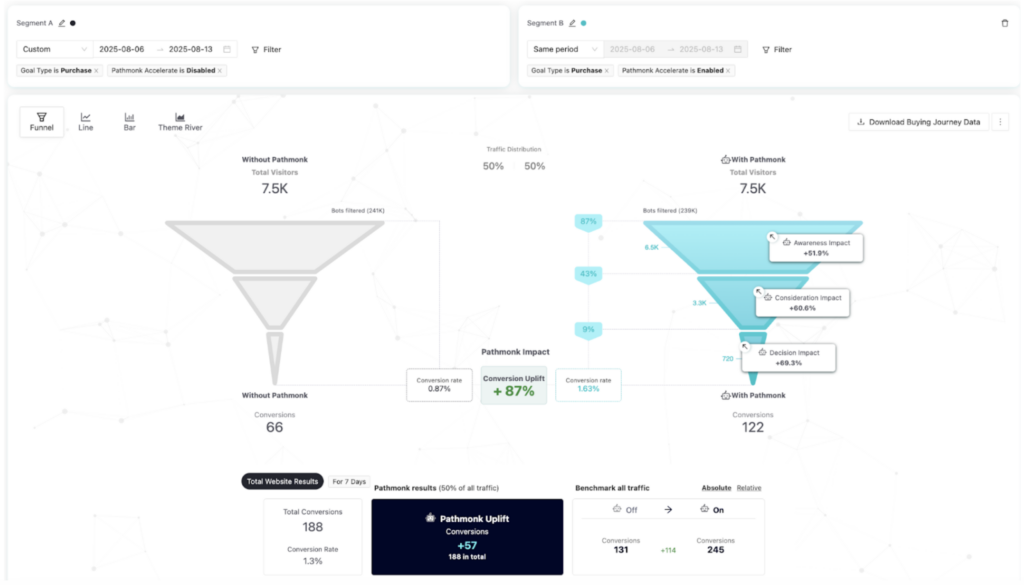
By adapting what was shown before the decision, while keeping the journey itself simple and focused, Pathmonk helped users move forward without adding pressure or complexity. The result was an 87% increase in qualified leads in just one week, achieved purely through intent-based on-site guidance, with no traffic changes or redesigns.
FAQs about exit-intent popups
Why do many exit-intent popups feel intrusive or ineffective?
Because they rely on exit behavior alone. An exit signal doesn’t explain why a visitor is leaving or how ready they were to convert. Without that context, the message often feels generic, poorly timed, or disconnected from what the visitor was trying to do.
What’s the difference between exit intent and user intent?
Exit intent is a momentary signal that someone is about to leave. User intent is inferred from behavior over time, such as pages visited, interactions, depth of engagement, and repeat visits. Intent provides context, while exit intent only provides timing.
When does exit intent actually make sense to use?
Exit intent makes sense when it’s layered on top of intent signals. For example, reinforcing trust or clarifying next steps for visitors who already showed strong buying behavior. Without that behavioral context, exit intent is mostly guesswork.
What’s a better alternative to traditional exit-intent popups?
Intent-aware microexperiences that adapt earlier in the journey. Instead of waiting until a visitor leaves, the website responds dynamically based on how the visitor behaves, adjusting messaging, format, and CTAs to match readiness.
How does intent-based personalization improve results compared to exit intent alone?
It makes optimization more predictable. High-intent visitors receive clarity and reassurance, while lower-intent visitors receive guidance instead of pressure. This reduces friction, improves engagement, and leads to more explainable and sustainable conversion gains.
Increase +180% conversions from your website with AI
Get more conversions from your existing traffic by delivering personalized experiences in real time.
- Adapt your website to each visitor’s intent automatically
- Increase conversions without redesigns or dev work
- Turn anonymous traffic into revenue at scale
Key takeaways
- Exit-intent popups are not outdated, but their effectiveness is limited when they rely on timing alone instead of understanding intent.
- Exit intent is a weak signal on its own. It shows that a visitor is leaving, not why they’re leaving or how ready they were to take action.
- The real performance gains come from understanding behavior before the exit, not reacting at the last possible moment.
- Generic exit popups fail because they treat all visitors the same, regardless of intent or readiness.
- Modern exit strategies work best when they are intent-aware, adjusting message, format, and CTA based on how visitors behave.
- Intent-based personalization turns exit intent from a reactive interruption into a contextual, supportive intervention.