

Is CRO even worth it for small sites with low traffic? Yes, Conversion Rate Optimization, or CRO, is still worth it for small sites with low traffic, but it needs to be approached differently. When traffic is limited, every visitor has more value, so even small improvements in clarity, trust, or usability can have a noticeable impact on conversions. CRO at this stage is less about chasing big percentage lifts and more about making sure your site communicates clearly, removes obvious friction, and gives visitors a good reason to act.
That said, traditional A/B testing usually isn’t practical with low traffic because it takes too long to reach statistically meaningful results. Instead, CRO should focus on qualitative insights and high-impact fixes: improving your value proposition, tightening CTAs, reducing form friction, and adding basic social proof. Measuring success through simple before-and-after comparisons is often enough. In short, CRO for small sites isn’t about perfect experiments, but about making smarter decisions so the traffic you already have converts better.
Table of Contents
Most people asking whether CRO is worth it for low-traffic websites already suspect the answer is no. And to be fair, a lot of CRO advice gives them plenty of reasons to think that. When you’re getting a few hundred visits a month, being told to run A/B tests, wait for statistical significance, and iterate endlessly on small UI changes sounds disconnected from reality. You don’t have the volume, the time, or the patience for that.
But the problem isn’t CRO itself. It’s how CRO is usually framed. Conversion rate optimization didn’t stop working just because your traffic is low. What stops working is applying enterprise-level playbooks to small websites. If you approach CRO as a numbers game, low traffic makes it feel pointless. If you approach it as a way to make clearer decisions, reduce friction, and get more value out of the visitors you already have, it becomes one of the few things that actually does make sense at this stage.
In this article, we’ll break down what CRO actually looks like when traffic is limited, what approaches are a waste of time for small sites, and how low traffic webs can use CRO to make better decisions and get more value out of every visitor they already have.
Get your website’s conversion score in minutes
- Instant CRO performance score
- Friction and intent issues detected automatically
- Free report with clear next steps
Why CRO is hard for low traffic websites?
CRO is hard for low-traffic websites because the entire discipline is built around volume. Most optimization frameworks assume you have enough visitors to test ideas quickly, isolate variables, and rely on statistics to tell you what’s working. When traffic is low, that foundation disappears. Tests drag on for weeks or months, results swing dramatically based on a handful of sessions, and even well-designed experiments can end up feeling inconclusive or misleading.
This creates a constant sense of uncertainty. You want to make data-informed decisions, but the data is thin and noisy. One good lead or one bad week can skew everything, making it difficult to separate real improvements from random variation. As a result, teams either overinterpret weak signals or get stuck waiting for “proper” results that never come.
On top of that, low-traffic sites usually operate with limited time and resources. There’s no dedicated CRO team, no backlog of experiments, and no patience for academic optimization exercises. Every change needs to justify its effort. That’s why applying traditional CRO tactics in this context often feels frustrating. The problem isn’t that conversion optimization doesn’t apply to small websites. It’s that the standard way CRO is practiced assumes conditions that simply don’t exist when traffic is scarce.
The biggest mistake: copying enterprise CRO playbooks
The biggest mistake small websites make with CRO is copying how large, high-traffic companies do it. Enterprise CRO looks polished, scientific, and reassuring. It also completely falls apart when you try to apply it without the volume to support it. What works for a site with millions of sessions a month becomes inefficient, and sometimes outright misleading, when you’re working with a few hundred or a few thousand visitors.
This usually shows up in very specific ways:
- Running A/B tests that take months to reach any kind of conclusion, only to end with “inconclusive” results.
- Optimizing tiny details like button colors, microcopy, or spacing while bigger issues around positioning or clarity remain untouched.
- Treating statistical significance as a prerequisite for action, which slows everything down.
- Gaining false confidence from weak results because one variant “won” with a very small sample size.
- Getting stuck in analysis paralysis, afraid to change anything without perfect data to back it up.
The irony is that this approach often makes small sites less decisive, not more. Instead of improving the experience, teams end up optimizing in theory while the site stays fundamentally confusing or ineffective. CRO turns into a performance of rigor rather than a tool for better decisions. For low-traffic websites, copying enterprise playbooks doesn’t make optimization safer. It makes it slower, noisier, and much easier to get wrong.
So, what CRO actually means for small sites?
For low traffic websites, CRO has very little to do with clever experiments or marginal gains. It’s much more basic than that. CRO, at this stage, is about making sure the site makes sense to someone who lands on it for the first time. If visitors don’t immediately understand what you do, who it’s for, and why they should care, no amount of testing will save you.
This is where CRO becomes practical instead of performative. The focus shifts to clarity, relevance, and friction removal. Clear positioning beats clever copy. Obvious next steps beat “creative” CTAs. Simple, predictable flows beat complex journeys designed to look sophisticated. When traffic is low, the biggest wins almost always come from fixing fundamentals that were never solid in the first place.
Seen this way, CRO isn’t about squeezing more conversions out of the same experience. It’s about removing reasons not to convert. Making the value proposition sharper, the message more consistent, and the path to action easier to follow. For small websites, good CRO looks less like optimization theatre and more like common sense applied consistently.
Free template: CRO audit checklist
- Identify conversion drop-offs across your funnel
- Spot friction points hurting performance
- Prioritize fixes with the biggest impact
Key CRO strategies for low traffic websites
When traffic is low, CRO stops being a numbers game and becomes a thinking exercise. You don’t optimize by running endless tests or waiting for large sample sizes you’ll never reach. You optimize by paying close attention to how real people interact with your site and removing anything that makes their decision harder. At this stage, CRO is about qualitative insight, not statistical perfection.
Instead of asking “what converts better?”, the more useful question is “what’s confusing, unclear, or slowing people down?”. Tools like heatmaps, session recordings, and basic user feedback help you spot friction quickly, even with very few visitors. The goal isn’t to prove anything with confidence intervals. It’s to understand why people hesitate, where they drop off, and what assumptions you’re making that don’t hold up in reality.
In practice, low-traffic CRO usually comes down to a few fundamentals:
- Making your positioning and value proposition painfully clear. If someone can’t explain what you do after a few seconds on your site, that’s the real conversion problem.
- Simplifying the UX instead of polishing it. Fewer choices, clearer paths, and more obvious next steps beat clever layouts every time.
- Watching real user behavior through recordings or scroll maps to see where people get stuck, hesitate, or give up.
- Listening to direct feedback from emails, support conversations, or short user interviews rather than relying on dashboards.
- Applying basic usability and persuasion principles consistently, instead of reinventing the wheel with every page.
For small sites, CRO isn’t about “winning tests”. It’s about learning faster and making fewer bad decisions. You trade statistical certainty for clarity, speed, and common sense. And at low traffic levels, that trade-off isn’t a compromise. It’s the only approach that actually works.
Calculate your increased profit in just a few clicks
Easily find out how many conversions and revenue you can expect once Pathmonk is installed on your website.
Calculate your gains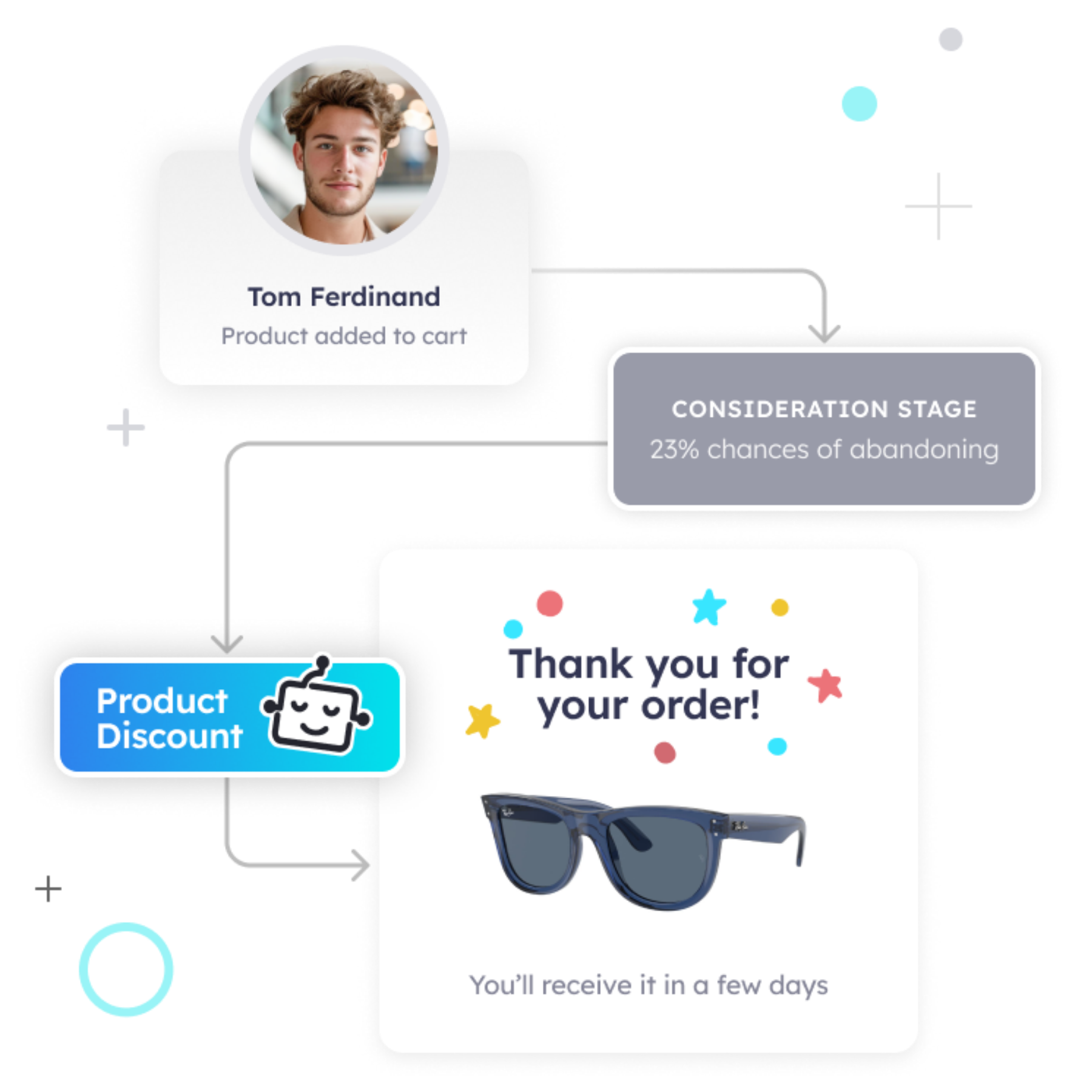
Make every visitor count with personalized interactions for low-traffic sites
When traffic is low, you need to make the most out of every visit you get. You can’t afford to wait for statistical significance to decide whether a button should be red or green, or whether “Book a demo” converts better than “Request a demo”. By the time you get an answer, you’ve already wasted dozens of visits that could have been handled better.
This is where most CRO approaches break down for small websites. They assume you’ll eventually get enough data to validate decisions. Pathmonk doesn’t. Instead of optimizing based on what might work on average, it focuses on what should happen for the person who’s on your site right now. Pathmonk reads behavioral signals in real time and predicts the visitor’s next most likely action, adapting the experience as the session unfolds.
In practice, this means:
- You don’t show the same generic experience to everyone.
- Hesitant visitors aren’t pushed into hard conversions too early.
- High-intent visitors aren’t slowed down by unnecessary steps.
- Exploratory traffic gets guidance and context instead of pressure.
- Ready-to-convert users get a clearer, shorter path to action.
For low-traffic sites, this changes the role of CRO entirely. You stop optimizing for averages you barely have data on, and start optimizing individual journeys instead. Pathmonk makes CRO usable from day one, not because it ignores data, but because it doesn’t need volume to create relevance. When every visit counts, improving each interaction in real time is far more effective than waiting months to confirm what you already suspect.
Does Pathmonk require a minimum traffic threshold?
No, Pathmonk doesn’t require a hard minimum traffic threshold to start working, and that’s actually one of its advantages for small and early-stage websites.
Traditional CRO tools and A/B testing platforms often feel like they require a certain volume of visitors before you can trust results. That’s because they’re built around statistical significance — you need a lot of data to confidently say that one variation performed better than another. With low traffic, those tests can take weeks or months, making the whole process slow and frustrating.
Pathmonk works differently. It doesn’t wait for volume or large sample sizes to “unlock” optimization. Instead, it uses real-time behavioral signals to understand visitor intent as sessions happen and adjusts the experience in the moment. Because it adapts to each individual visitor rather than aggregating results over long periods, it starts delivering value even with a small number of monthly visits.
That said, there are a couple of things worth noting:
- More traffic still helps: as your traffic grows, Pathmonk has more behavioral data to refine predictions and personalization patterns. For accurate A/B test reporting, we recommend reaching at least 10,000 pageviews monthly, but it doesn’t depend on volume to start working.
- Success isn’t measured by statistical thresholds: the goal isn’t to wait for significance, it’s to improve relevance and reduce friction for the visitors you do get.
- Real impact comes from quality of interactions, not quantity of visitors: so even sites with hundreds of visits a month can see improved engagement and conversions because personalization starts on the first visit.
How B2B manufacturer Forrest Technical Paintings increased +63% sales requests with Pathmonk
Forrest Technical Painting is a B2B manufacturing company specializing in high-performance industrial coatings. Like many industrial and manufacturing websites, traffic volumes were inherently low. The audience was niche, the buying cycle was complex, and growth wasn’t about driving more visitors, but about doing more with the few relevant ones they already had.
The problem was that those visits rarely turned into sales requests. The website was outdated and difficult to change, and the marketing team had almost no developer resources available. Traditional CRO approaches weren’t realistic either. With limited traffic, running long A/B tests or experimenting with small design changes would have taken months to produce unreliable results.
Pathmonk addressed this exact constraint. Instead of optimizing pages over time, we focused on improving each visit as it happened.
Using real-time behavioral signals, Pathmonk identified where each visitor was in the buying journey and adapted the experience accordingly. Early-stage visitors received clear explanations of Forrest’s expertise and value. Consideration-stage visitors saw credibility signals such as certifications and durability proof. High-intent visitors were guided directly to the sales request form, with friction removed.
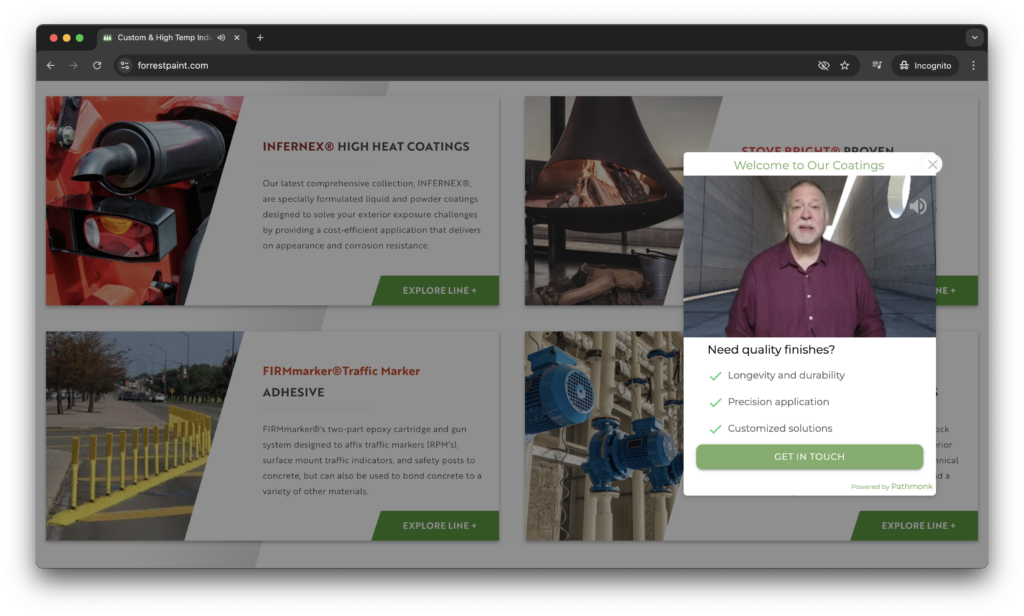
All of this happened without redesigning the website or waiting for statistically significant test results. The buying journey improved immediately, session by session.
Over six months, the impact was clear:
- 169 additional high-ticket sales requests were directly attributable to Pathmonk
- Sales request conversion rate increased by 63% (from 1.49% to 2.43%)
- The strongest lift happened early, with a 303% increase in sales requests in the first week
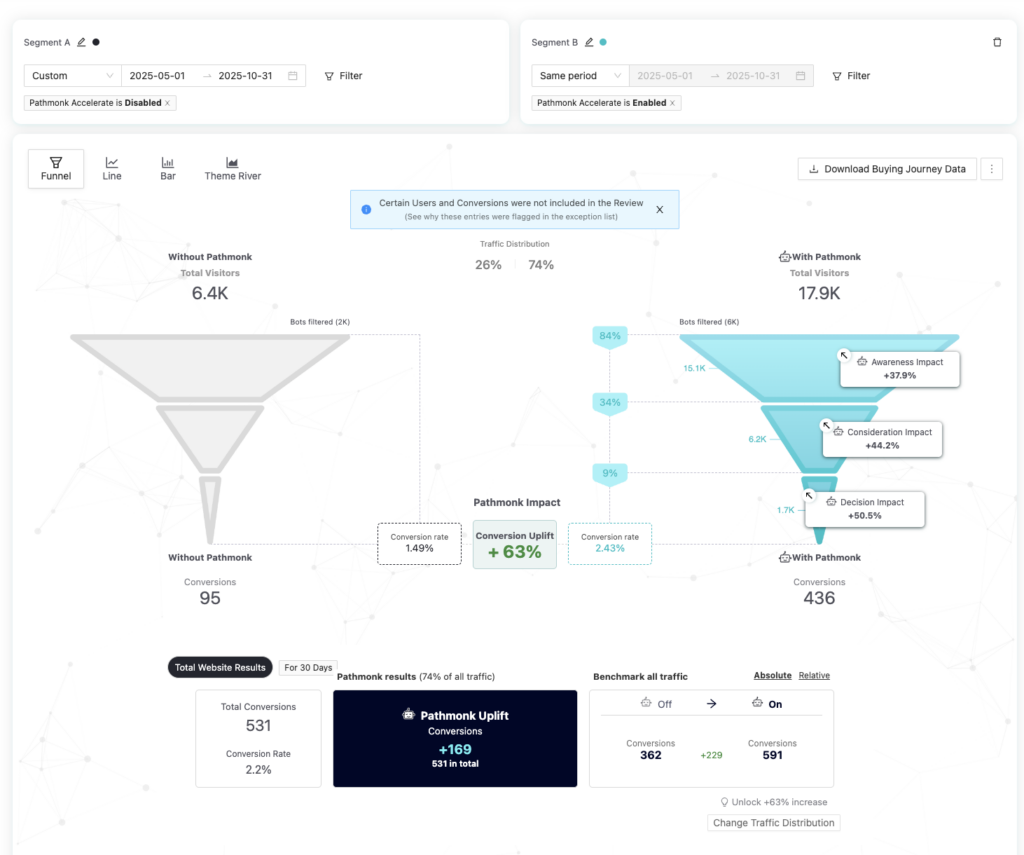
This is why CRO still matters for low-traffic sites. Forrest didn’t need more visitors or perfect data. They needed to make each visit count. By focusing on individual journeys instead of averages, they turned a low-volume website into a consistent source of qualified sales requests.
FAQs on low traffic CRO
Why is A/B testing difficult with low traffic?
Because statistical significance takes too long to reach. With low traffic, test results fluctuate heavily based on a small number of sessions, which makes conclusions unreliable. You either wait months for an answer or end up acting on weak data anyway. That’s why low-traffic CRO relies more on qualitative insights and directional improvements than formal testing.
What kind of CRO works best for small or niche websites?
The most effective CRO for small sites focuses on fundamentals: clear positioning, simple user flows, obvious next steps, and reduced friction. Instead of optimizing tiny UI elements, small sites benefit more from fixing messaging gaps, guiding visitors based on intent, and making the buying journey easier to understand.
How is Pathmonk different from traditional CRO tools?
Traditional CRO tools optimize based on aggregated data and historical test results. Pathmonk works in real time. Instead of waiting to learn what works on average, it adapts the experience based on how each visitor behaves in the moment. This makes it far more practical for low-traffic or early-stage websites.
Can CRO really impact B2B sites with low traffic?
Yes, and B2B sites are often where CRO matters most. Traffic is usually limited but highly qualified, and buying journeys are complex. Improving relevance, guidance, and timing can have a direct impact on sales requests and pipeline, even without increasing traffic.
What should low-traffic sites measure instead of statistical significance?
Low-traffic sites should focus on before-and-after trends, funnel movement, engagement quality, and conversion lift over time. The goal isn’t mathematical certainty, but consistent improvement. Directional gains and better visitor experiences matter more than perfect confidence intervals at this stage.
Key takeaways
- CRO is worth it for low-traffic websites, but traditional A/B testing and statistical significance-based methods are often impractical at low volume.
- With low traffic, qualitative insights and real-time behavior matter more than aggregated data and long test cycles.
- Directional improvements and before-and-after comparisons are more useful than waiting for statistically perfect results.
- For low-traffic B2B and niche websites, making every visit count is often more effective than focusing on traffic growth alone.
- Session-level optimization and intent-based personalization are better suited to low-traffic environments than traditional CRO tools.
Increase +180% conversions from your website with AI
Get more conversions from your existing traffic by delivering personalized experiences in real time.
- Adapt your website to each visitor’s intent automatically
- Increase conversions without redesigns or dev work
- Turn anonymous traffic into revenue at scale