

Is conversion rate optimization worth the investment? The short answer would be “yes”, but Conversion Rate Optimization (CRO) is worth the investment when a business has steady, relevant traffic, a clear primary conversion goal, and the willingness to optimize over time rather than chase quick wins. In these scenarios, CRO improves revenue efficiency, lead quality, and time to conversion without increasing acquisition spend.
CRO is not effective when traffic is too low or misaligned, product-market fit is unclear, or conversion goals constantly change. In those cases, optimization cannot compensate for structural growth problems.
The return on CRO does not come from isolated A/B tests, but from compounding improvements across the user journey. Modern, behavior-based approaches, including tools like Pathmonk, increase ROI by adapting experiences in real time based on user intent, reducing dependency on high traffic volumes and long experimentation cycles.
Table of Contents
Conversion rate optimization is one of those disciplines everyone agrees is important, yet many companies still treat as optional. Traffic acquisition gets budget by default. CRO gets questioned. Is it really worth the investment? Will it move the needle, or just generate incremental improvements that look good in reports but don’t justify the effort?
The problem isn’t CRO itself. It’s how ROI is usually framed.
CRO doesn’t behave like paid acquisition, where you spend more and expect more volume. Its impact is less visible in the short term and harder to attribute to a single action. Results compound over time, across touchpoints, journeys, and segments. When expectations are set around quick wins or isolated tests, CRO almost always looks disappointing.
This article looks at CRO from an ROI perspective that reflects how it actually works in practice. We’ll break down where returns come from, what a realistic payoff looks like, and when investing in CRO makes sense.
What conversion rate optimization actually means today
For a long time, conversion rate optimization was reduced to tactics. Change the headline. Test a button. Shorten a form. Useful, yes, but limited.
Today, CRO is (or should be) something else: a system.
A system for understanding why people are on your site, what they’re trying to do, and how likely they are to take action right now. The goal isn’t to improve individual pages in isolation, but to make the entire path to conversion more efficient.
That’s an important distinction, because ROI doesn’t come from one good test. It comes from removing friction across many interactions, over time.
This is also why CRO can’t live on A/B testing alone anymore. Testing assumes that one version should win for everyone. In reality, different visitors need different things. Someone comparing options shouldn’t see the same experience as someone ready to book a demo.
The reality is that two visitors can land on the same page with very different levels of readiness. One is still exploring. Another is validating a decision. Treating them the same is convenient, but inefficient. Modern CRO uses behavioral signals to infer intent and adapt the experience accordingly, instead of forcing everyone down the same funnel.
This naturally leads to contextual personalization. Not in the sense of endlessly creating variants, but in choosing the most relevant next step based on what the user is doing.
Free template: CRO audit checklist
Discover everything you need to start identifying drop-offs and increase conversions.
The real cost of CRO (and why it’s often underestimated)
When teams talk about the cost of conversion rate optimization, they usually mean tools. Sometimes an agency. Almost never the full picture. That’s why its ROI is so often misjudged. The investment is underestimated upfront, and the returns are expected too quickly.
The most obvious costs are direct. A CRO tool. Analytics. Maybe external support. Those are easy to budget and most of the time relatively easy to justify.
What’s less visible is the internal cost. CRO requires time from people who are already stretched: marketing, product, design, sometimes development. Even when changes don’t require code, decisions still require alignment. Reviews take time. Learnings take time. None of that shows up as a line item, but it’s very real.
Then there’s the opportunity cost, which is usually ignored altogether.
Every month a website runs without optimization, the business is paying to acquire traffic that converts below its potential. Now read that again and let it sink in. That cost doesn’t appear in a CRO budget, but it quietly compounds in paid media spend, missed leads, and underperforming funnels.
This is where many CRO initiatives fail. Not because CRO is expensive, but because it’s treated as a side project. A few tests here and there, squeezed between other priorities, with the expectation that results should still be immediate.
That approach almost guarantees disappointment.
This is why approaches that incorporate real-time behavior analysis and intent-based personalization tend to shift the economics. By acting on user signals as they happen, rather than waiting weeks for statistical significance, teams can extract value earlier and reduce the hidden cost of slow experimentation.
Pathmonk doesn’t eliminate the need for CRO work, but they change where the effort goes. Less time spent guessing what to test. Less dependency on traffic volume. More focus on capturing value from the traffic that’s already there.
Understanding the real cost of CRO is not about scaring teams away from it. It’s about setting expectations correctly. When CRO is treated as a system-level investment rather than a cheap experiment, its ROI becomes much easier to evaluate, and much harder to dismiss.
Where CRO ROI actually comes from
The ROI of conversion rate optimization rarely comes from a single breakthrough. It comes from several smaller effects that stack over time. When teams look for one dramatic uplift, they usually miss where the real value is being created.
In practice, CRO ROI shows up in four places.
- First, higher revenue from existing traffic. This is the most obvious one, but also the most misunderstood. CRO doesn’t increase demand. It increases efficiency. When more visitors complete meaningful actions, every acquisition channel becomes more profitable without increasing spend. Even small conversion improvements compound quickly once volume is there.
- Second, better lead quality. CRO is not only about getting more conversions, but about shaping who converts and when. When experiences are aligned with user intent and journey stage, low-intent visitors self-select out earlier, while high-intent users face less friction. The result is fewer unqualified leads and more conversations that actually move forward, which directly impacts sales efficiency.
- Third, shorter buying cycles. Many websites unintentionally slow users down by forcing everyone through the same path. CRO reduces unnecessary steps for users who are already close to a decision, while giving earlier-stage visitors the information they need to progress. This alignment removes delays, reduces back-and-forth with sales, and accelerates time to revenue.
- Fourth, better decision-making across teams. A mature CRO program generates continuous insight into how users behave, what they respond to, and where they get stuck. Those insights don’t stay confined to marketing. They influence messaging, positioning, pricing, product priorities, and even sales scripts. This is harder to quantify, but over time it’s one of the strongest contributors to ROI.
What ties all of this together is compounding impact. CRO improvements rarely spike revenue overnight. They quietly raise the baseline. Each optimization makes the next one more effective, because the system becomes better aligned with real user behavior.
What realistic CRO looks like (and what it doesn’t)
One of the biggest mistakes teams make when evaluating CRO ROI is comparing themselves to published benchmarks. Average uplift percentages, “industry standards”, and success stories look reassuring, but they’re usually disconnected from real operating conditions.
Most benchmarks are misleading because they strip out context. They don’t account for traffic quality, conversion intent, business model, or how mature the optimization program actually is. As a result, they set expectations that are either unrealistic or irrelevant.
Factors that will affect your CRO efforts
ROI will be shaped by a small number of structural factors that matter far more than individual tactics.
- Traffic volume is one of them. More traffic increases the speed at which learnings compound, but it doesn’t guarantee better ROI. Low-volume sites can still see strong returns if traffic is qualified and optimization focuses on high-impact conversion paths.
- Business model also plays a major role. In SaaS, CRO often affects lead quality, activation, and pipeline velocity. In e-commerce, the impact is more directly tied to checkout efficiency and average order value. In services, CRO influences inquiry quality and sales efficiency more than raw conversion rate. Comparing ROI across these models rarely makes sense.
- Sales complexity further changes the picture. When conversion is the start of a multi-touch sales process, CRO ROI shows up in downstream metrics like close rate and deal size, not just form submissions. Short-term conversion uplifts can be misleading if lead quality drops.
- Finally, baseline conversion rate matters. A site converting at 0.5% has more obvious friction to remove than one already converting at 5%. Early gains are often easier, but also less predictive of long-term impact.
What CRO timelines really look like
Another common misconception is that CRO should pay off immediately. In reality, CRO timelines follow two parallel tracks.
- In the short term, teams may see incremental gains from fixing obvious friction points or improving clarity. These wins are useful, but limited.
- The real value shows up in the long term, as learnings accumulate and experiences become better aligned with user intent. This is where compounding impact kicks in. Each improvement raises the baseline, making future optimizations more effective.
Expecting immediate, dramatic wins is often the fastest way to kill a CRO program. When early results are judged too harshly, teams stop experimenting, insights dry up, and ROI never has the chance to materialize.
This is also why behavior-based CRO changes expectations. When optimization happens in real time, Pathmonk can start influencing outcomes earlier by adapting experiences as users interact with the site, rather than waiting for long test cycles to conclude.
Free template: CRO testing framework
Organize, prioritize, and execute conversion rate optimization tests with our framework.
When CRO is worth the investment (and when it’s not)
Conversion rate optimization is not a universal fix. In the right conditions, it compounds value quickly. In the wrong ones, it turns into expensive noise. Being clear about this upfront is what separates effective CRO programs from performative ones.
When CRO is worth the investment
- CRO makes sense when you already have steady traffic. That doesn’t mean massive volumes, but it does mean consistent, relevant visitors. CRO optimizes existing demand. If there’s nothing to optimize, there’s no leverage.
- It also requires a defined primary conversion goal. Whether that’s a demo request, signup, or lead submission, CRO needs a clear success signal. Without it, optimization becomes subjective and ROI impossible to measure.
- CRO is worth investing in when you’re willing to run experiments long enough to learn. Not every test wins. Many don’t. The value comes from accumulation of insight, not from isolated uplifts. Teams that expect immediate results usually abandon CRO right before it starts paying off.
- Finally, CRO is especially valuable when you want to scale without proportional increases in ad spend. At a certain point, buying more traffic becomes less efficient. CRO shifts the focus from acquisition volume to conversion efficiency, improving returns across all channels using the same traffic base.
When CRO is not the priority
- CRO should not be the focus when traffic is too low or irrelevant. If most visitors are not in the target audience, optimization won’t fix that. Traffic quality problems need acquisition or positioning fixes, not CRO.
- It’s also the wrong investment when product-market fit is not there. CRO can reduce friction, but it can’t create demand or compensate for a product that doesn’t solve a clear problem. Optimizing a broken offer only makes failure more efficient.
- Finally, CRO struggles when conversion goals are unclear or constantly changing. If teams can’t agree on what success looks like, CRO turns into endless debate. Stable goals are a prerequisite for meaningful optimization and credible ROI analysis.
The conclusion here is simple: CRO is worth the investment when there’s something real to optimize and a willingness to treat it as a system, not a quick fix.
Why traditional CRO approaches struggle to show results
Many conversion rate optimization programs don’t fail because CRO doesn’t work. They fail because the way it is implemented makes ROI hard to realize, measure, or sustain.
- One of the main issues is over-reliance on A/B testing, especially when traffic is limited. Testing is powerful, but only under the right conditions. When volume is low, tests take too long to reach significance, insights arrive late, and momentum disappears. Teams end up optimizing what’s easiest to test, not what matters most.
- Another structural problem is the use of static experiences for very different users. Traditional CRO often assumes there is a single “best” version of a page. In reality, visitors arrive with different intent, levels of awareness, and readiness to convert. Showing the same experience to everyone flattens performance and hides potential gains.
- Slow iteration cycles make this worse. Between hypothesis creation, implementation, QA, test runtime, and analysis, weeks or months can pass before a single decision is made. By the time learnings are applied, traffic patterns, campaigns, or priorities may have already shifted. The longer the loop, the harder it is to attribute impact.
- Finally, CRO often suffers from fragmented tools and data. Behavioral insights live in analytics. Tests live somewhere else. Personalization, if it exists at all, is handled separately. This fragmentation makes it difficult to connect user behavior to outcomes, and even harder to build a coherent optimization strategy.
Individually, these issues seem manageable. Together, they explain why many CRO initiatives struggle to demonstrate ROI, even when the underlying opportunity is real. The problem is not the goal of optimization, but the limitations of traditional approaches in environments that demand speed, relevance, and adaptability.
How Pathmonk fits into a modern CRO stack
Most optimization setups rely on retrospective analysis. Teams look at aggregated data, run experiments, wait for results, and then decide what to change. That approach can work, but as we’ve just seen it is slow and highly dependent on stable conditions and sufficient traffic volume.
In practice, user behavior is not static. Visitors change their level of interest during a session, consume information at different speeds, and reach decision points at different moments. A large part of conversion loss happens during these transitions, before any experiment produces a result.
Pathmonk operates at that level, by responding to behavioral signals as they occur. The goal is not to determine a single best experience, but to adapt the experience based on how a user is interacting with the site at a given moment.
This changes how value is generated. Optimization does not depend entirely on running tests to completion or reaching high traffic thresholds. Improvements can happen during the session itself, which shortens the time between insight and impact.
Pathmonk is used to improve and shorten the path to conversion, considering factors such as what content is shown, when it appears, and how it aligns with the user’s apparent level of intent. Experimentation still plays a role in validating assumptions and understanding patterns, but behavior-based adaptation allows teams to apply those learnings continuously rather than episodically.
How Pathmonk generated a 5× ROI for Porter Art Guild in their first month
Porter Art Guild is a B2C ecommerce brand with a large, visually rich art catalog. Traffic volume was strong and interest was high, but conversions lagged. Visitors often took weeks and dozens of visits before purchasing. The problem wasn’t demand, it was decision friction. The site was beautiful, but navigating the catalog and choosing the right piece felt overwhelming.
Redesigning the site or restructuring collections would have required significant time and effort, with no guarantee of impact. Instead, the focus shifted to improving how visitors made decisions within the existing experience.

Pathmonk was implemented to identify each visitor’s intent stage in real time and guide them accordingly. Early-stage visitors received clarity around the brand and collections, mid-stage visitors saw contextual guidance to help compare options, and high-intent visitors were nudged toward completing a purchase. This was done without changing the website or increasing traffic.
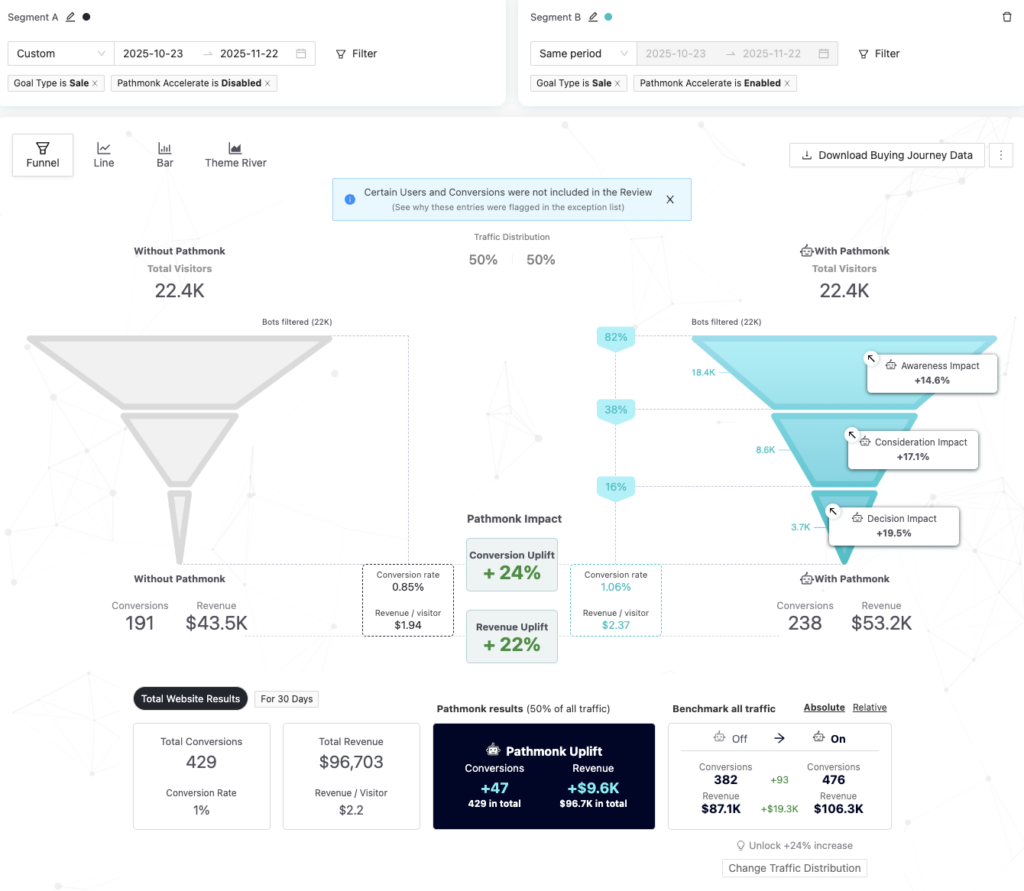
Pathmonk was initially shown to 50% of visitors, allowing for a clean comparison.
After 30 days:
- $9,600 in incremental revenue was generated
- Pathmonk subscription cost: $2,000
- ~5× ROI in the first month
- Conversion rate increased from 0.85% to 1.06%, a +24% lift that translated into meaningful revenue
How to estimate CRO ROI for your business
Estimating the return of conversion rate optimization doesn’t require complex models or assumptions about dramatic uplifts. What matters is understanding your current baseline and how small efficiency gains translate into revenue over time.
To get a realistic estimate, you only need a few inputs:
- Monthly traffic to the pages you want to optimize
- Current conversion rate for your primary goal
- Average value per conversion, whether that’s revenue, pipeline value, or qualified leads
- A conservative improvement range, not best-case scenarios
The key mistake teams make at this stage is overestimating impact. CRO works through incremental gains that compound, not sudden spikes. Even modest improvements often have a meaningful effect once applied consistently across traffic.
To simplify this process, you can use the Pathmonk calculator:
https://calculator.pathmonk.com/
The calculator helps you model how changes in conversion rate affect outcomes based on your actual traffic and conversion data.
Calculate your increased profit in just a few clicks
Easily find out how many conversions and revenue you can expect once Pathmonk is installed on your website.
Calculate your gains
FAQs about CRO ROI and implementation
Should CRO be handled by marketing, product, or growth teams?
There is no single correct owner. CRO typically sits at the intersection of marketing, product, and analytics. The most effective setups treat CRO as a shared system, with clear ownership over prioritization and measurement, rather than as a siloed responsibility.
How much traffic do you need to justify investing in CRO?
There is no fixed minimum. What matters more than volume is traffic relevance and consistency. While traditional experimentation benefits from higher traffic, behavior-based optimization can create value even at lower volumes by acting on intent signals instead of relying solely on statistical significance.
What usually blocks CRO initiatives inside companies?
The most common blockers are unclear conversion goals, lack of alignment between teams, and unrealistic expectations around speed of results. CRO tends to fail when it’s treated as a short-term initiative instead of a continuous optimization process.
Can CRO replace the need for more traffic?
No. CRO does not replace acquisition. It improves how efficiently existing demand is converted. In practice, CRO and acquisition work best together, with CRO increasing the return on every channel that brings users to the site.
Key takeaways
- Conversion rate optimization is worth the investment when there is steady, relevant traffic and a clearly defined conversion goal.
- The return from CRO comes from compounding efficiency gains, not from isolated A/B test wins.
- Published CRO benchmarks are often misleading because ROI depends heavily on context, not averages.
- CRO delivers value beyond conversion rate by improving lead quality, sales efficiency, and time to conversion.
- Expecting immediate results is one of the most common reasons CRO programs fail.
- Behavior-based approaches allow optimization to happen during the session, reducing reliance on high traffic volumes and long testing cycles.