

Is my conversion rate low because of traffic quality or my website? A low conversion rate is usually caused by either traffic quality or a website mismatch, and you can tell which by looking at behavior. If users bounce quickly, don’t scroll, and don’t interact, the problem is traffic quality. This often comes from misaligned channels, broad targeting, or keywords that bring low-intent users to pages designed for high-intent actions.
If users do engage (they scroll, click, spend time) but still don’t convert, the issue is your website. That points to unclear value propositions, CTAs that don’t match user readiness, friction in forms or checkout, or too much being asked too early. When results vary by channel or behavior, the real problem isn’t traffic or design alone, but lack of segmentation and intent-based experiences.
Table of Contents
You’re getting traffic, but conversions are not where they should be.
At that point, most teams ask the same question: is the problem the quality of the traffic, or is something wrong with the website?
It’s a fair question. A low conversion rate doesn’t automatically mean your website is bad. And it doesn’t always mean your traffic is low quality either. In most cases, the issue sits somewhere in between, and looking at the conversion rate alone won’t tell you where things are breaking.
In this article, we’ll help you understand how to tell the difference between a traffic quality problem and a website experience problem. You’ll learn what signals to look at, how to diagnose the real cause of low conversions, and why treating all visitors the same often leads to misleading conclusions.
What “low conversion rate” actually means (and when it’s misleading)
Before trying to fix a low conversion rate, it’s important to clarify what “low” actually means.
A conversion rate is simply the percentage of visitors who complete a desired action on your website. On its own, that number lacks context. A 1% conversion rate might be a problem for a high-intent page like a demo or pricing page, but it could be completely normal for top-of-funnel content such as blog posts targeting informational queries (learn more about conversion rate benchmarks per industry here).
This is where many teams go wrong: they compare their numbers to conversion rate averages without accounting for user intent, traffic source, or funnel stage. Industry benchmarks can provide a rough reference, but they rarely reflect how your audience behaves or what your pages are actually designed to achieve.
A low conversion rate can also be misleading when you look at it in aggregate. Mixing high-intent traffic (for example, branded search or bottom-funnel ads) with low-intent traffic (educational content or awareness campaigns) often pulls the overall number down. The result is a single metric that looks alarming but doesn’t accurately represent real performance.
In short, a low conversion rate isn’t automatically a sign that your website is underperforming. It’s a signal that needs to be interpreted in context, alongside traffic quality, visitor intent, and the goal of each page.
Get your website’s conversion score in minutes
- Instant CRO performance score
- Friction and intent issues detected automatically
- Free report with clear next steps
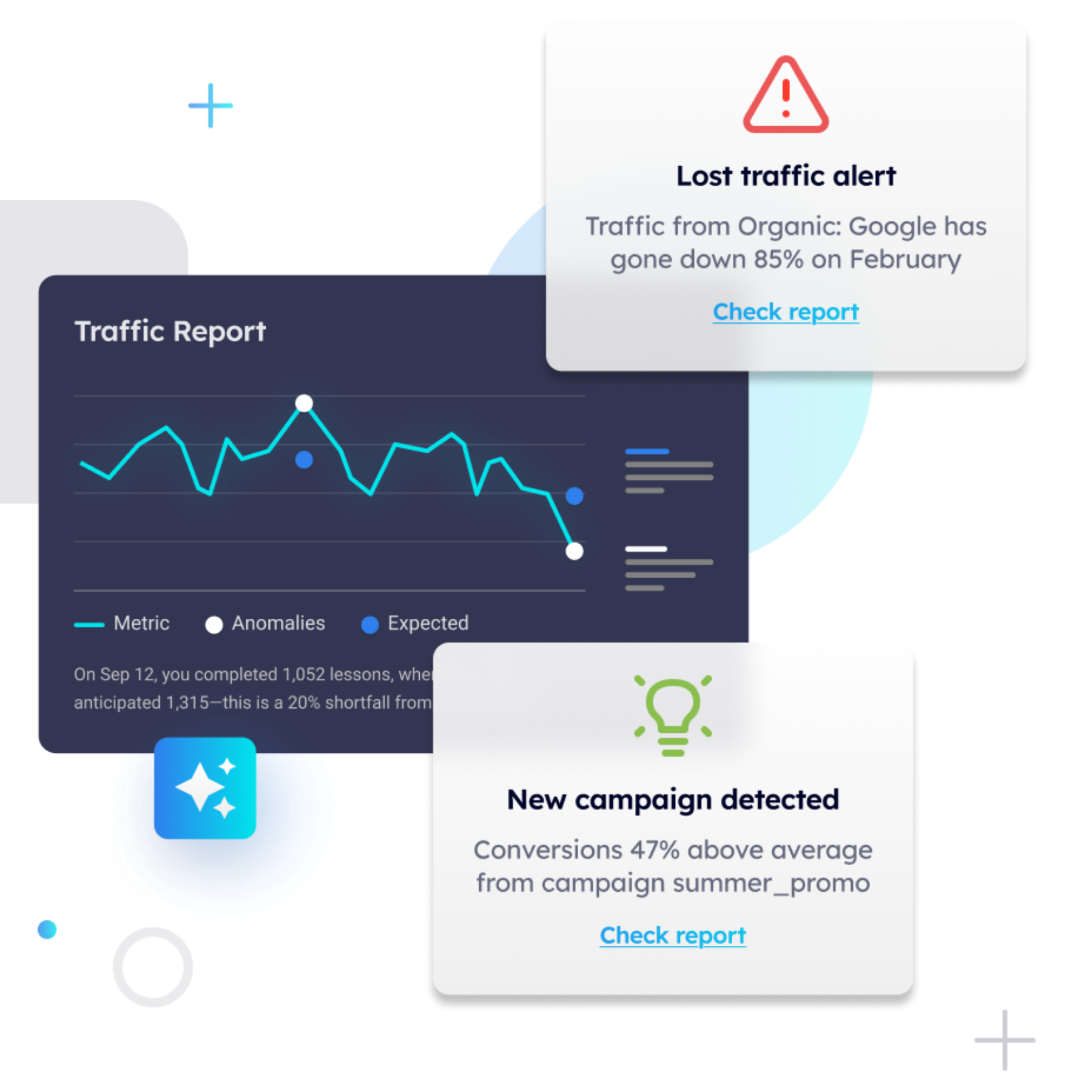
Signs your conversion problem is traffic quality
If your conversion rate is low, one of the first things to assess is traffic quality. Not all traffic is meant to convert, and bringing the wrong visitors to your site can drag down conversion rates even if your website is doing its job.
The signals below help you identify when the problem sits upstream, before users ever interact meaningfully with your pages.
1. You attract the wrong intent
One of the clearest signs of a traffic quality issue is a mismatch between user intent and what your website is offering.
This often happens when:
- Keywords rank well but attract informational intent, while the page is optimized for conversion
- Ads promise one outcome, but the landing page pushes a different one
- Content brings in early-stage users who are not ready to take action
For example, a visitor searching for “what is conversion rate optimization” is likely looking to learn, not to book a demo. If they land on a highly transactional page, the lack of conversion doesn’t mean the page is bad. It means the intent is wrong for the goal.
Informational vs commercial intent mismatches are especially common in SEO-driven traffic. Blog posts, guides, and educational content tend to attract curious users, not buyers. Expecting the same conversion behavior from both leads to misleading conclusions.
2. High traffic, low engagement
Another strong indicator of poor traffic quality is when traffic volumes look healthy, but engagement metrics are consistently weak.
Common signals include:
- High bounce rate, where visitors leave without interacting
- Very short session duration, suggesting users didn’t find what they expected
- Low scroll depth, indicating content wasn’t relevant enough to explore further
These metrics usually point to a relevance problem, not a persuasion problem. Users arrive, quickly realize the page doesn’t match their intent, and leave. In these cases, improving copy, CTAs, or design won’t fix conversions because the right audience isn’t there to begin with.
3. Channel-specific underperformance
Traffic quality issues often become visible when you break conversion data down by traffic source.
It’s common to see:
- One channel generating large volumes of traffic but very few conversions
- Another channel converting well but being masked by poor-performing traffic elsewhere
When all channels are blended into a single global conversion rate, underperforming sources can distort the picture. A strong-performing channel may be doing exactly what it should, while a low-intent channel pulls the average down and makes overall performance look worse than it is.
This is why channel-specific conversion rates and behavior analysis matter. Without segmentation, it’s easy to misdiagnose a traffic quality problem as a website problem, and focus optimization efforts in the wrong place.
Free template: CRO testing framework
Organize, prioritize, and execute conversion rate optimization tests with a clear, repeatable framework.
Free download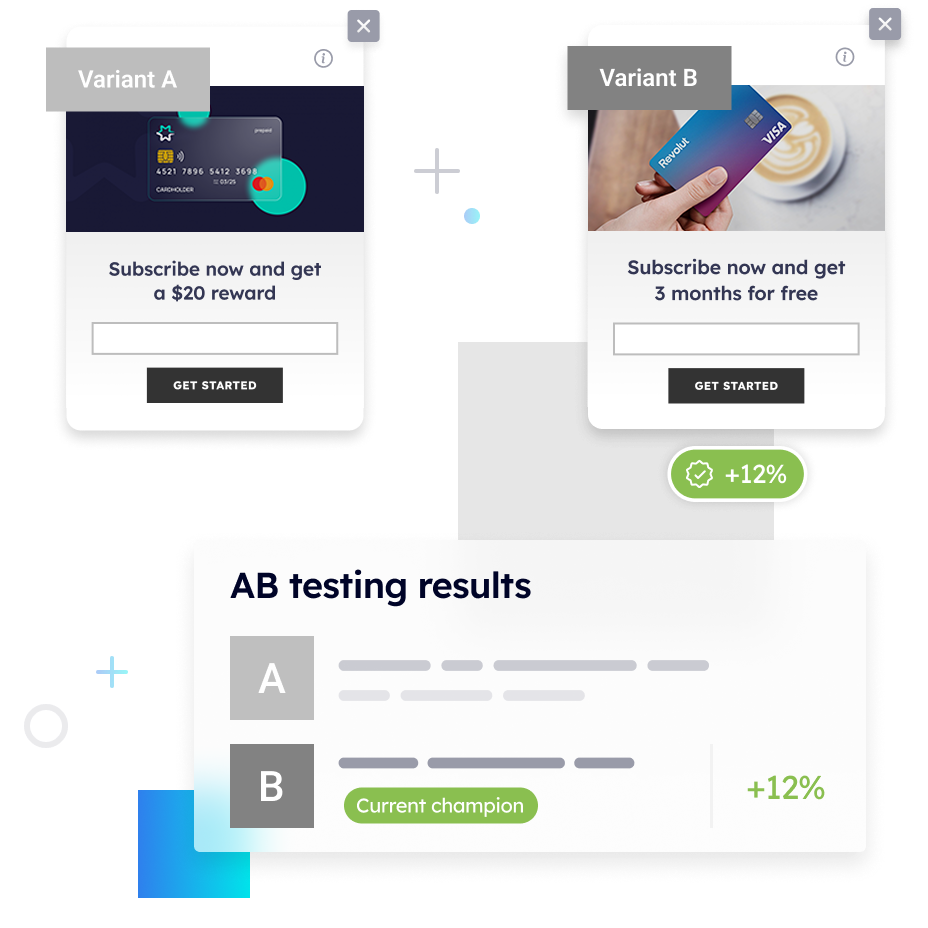
Signs your conversion problem is your website
When traffic quality looks solid but conversions are still underperforming, the issue is often the website experience itself. In this scenario, users arrive with the right intent, but something in the page prevents them from taking the final step.
This is where website conversion optimization becomes the focus.
1. Traffic engages but doesn’t convert
One of the clearest signals that your website is the bottleneck is engaged behavior without outcomes.
Visitors scroll through the page, interact with elements, and sometimes even visit multiple pages, yet they don’t complete the desired action. This pattern usually rules out traffic quality as the main problem. Users are interested enough to explore, but not confident enough to commit.
When this happens, the issue is rarely visibility or traffic volume. It’s more often about clarity, trust, or perceived risk. Something in the experience slows users down right before the decision point.
2. Messaging doesn’t match user expectations
Even high-intent visitors hesitate when the value proposition doesn’t align with what they expected to see.
This often shows up as:
- Messaging that is too generic for users with different intent levels
- Headlines that don’t clearly reinforce the promise made in ads, search results, or referrals
When the same message is shown to all visitors, regardless of where they are in the buying journey, relevance drops. Users may stay on the page, but they don’t feel like the offer is tailored to their specific situation, which is a common reason why visitors don’t convert.
3. Friction in the conversion path
Another frequent website-related issue is conversion friction.Small obstacles add up quickly:
- Overloaded forms that ask for too much information upfront
- Poor timing of CTAs, appearing before users are ready
- Asking for a high level of commitment too early in the journey
Even motivated visitors can abandon the process when the path to conversion feels heavy or rushed. In these cases, the problem isn’t demand. It’s that the website experience doesn’t make taking action feel easy or proportional to the value offered.
Calculate your increased profit in just a few clicks
Easily find out how many conversions and revenue you can expect once Pathmonk is installed on your website.
Calculate your gains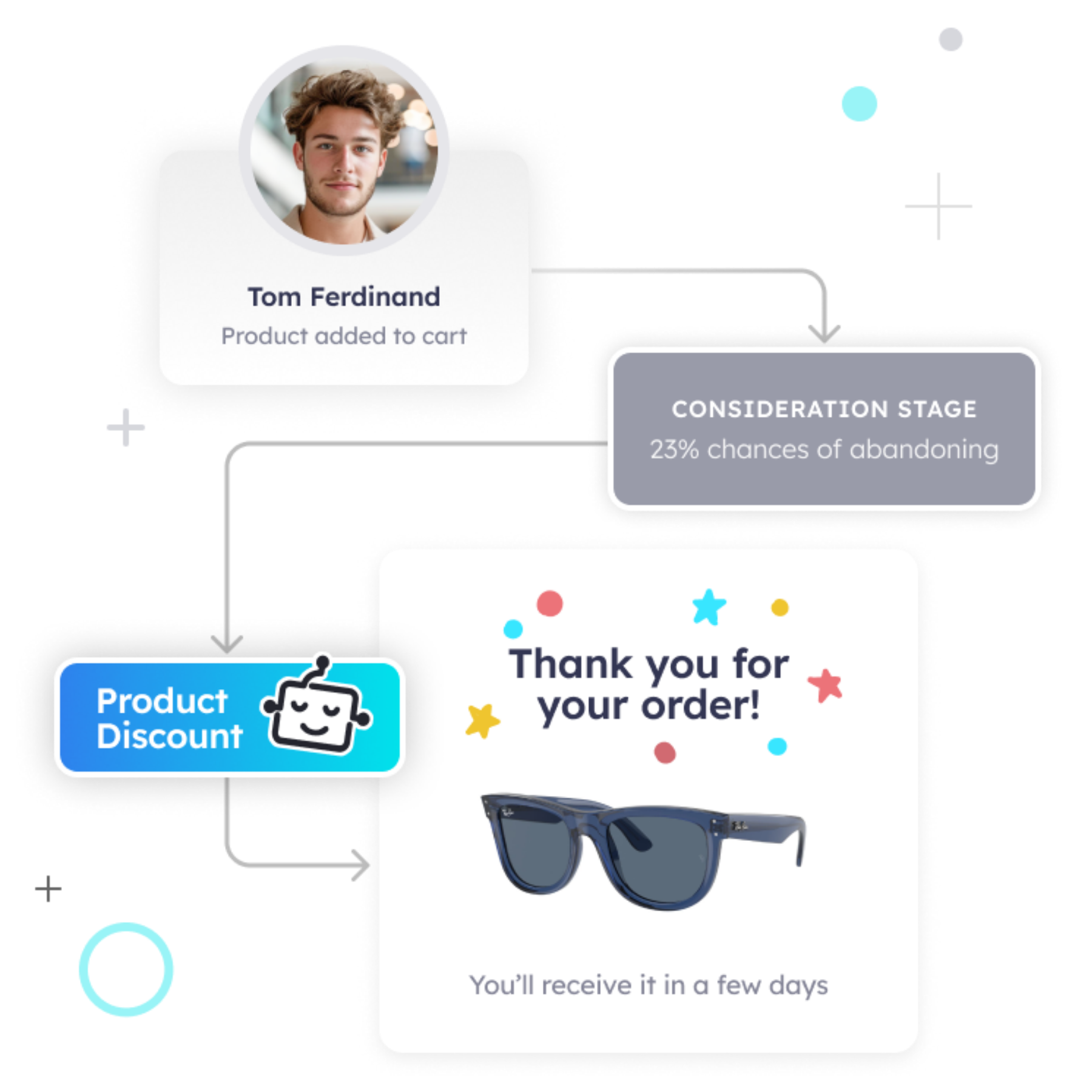
When it’s not either/or: the traffic–experience mismatch
In reality, most conversion problems aren’t caused by traffic quality or website experience in isolation: they come from a mismatch between the two.
Modern websites tend to assume a single, “average” visitor. Traffic acquisition, on the other hand, brings in people with very different levels of intent, awareness, and readiness to act. When those two worlds don’t align, conversions suffer, even when both traffic and website seem “good” on their own.
Why good traffic can still fail on a generic website
High-quality traffic doesn’t guarantee high conversions if the website experience is static.
A visitor arriving through branded search, a product comparison, or a high-intent referral expects clarity, reassurance, and a fast path to action. When they’re met with the same generic messaging shown to first-time, exploratory visitors, friction appears.
The website technically works, but it doesn’t respond to intent. As a result:
- High-intent users are forced to wade through irrelevant information
- Decision-ready visitors don’t get the validation they need at the right moment
In these cases, conversion rates drop not because traffic quality is poor, but because the website fails to adapt to users who are already close to converting.
Why a good website can’t save poor-quality traffic
And guess what, the opposite is also true.
A well-designed website with strong messaging and clean UX can’t compensate for low-intent traffic. If visitors arrive looking for education, inspiration, or general information, no amount of optimization will suddenly turn them into buyers.
This is why pushing aggressive CTAs on early-stage traffic often backfires. The website isn’t broken. It’s simply being asked to convert users who aren’t ready.
Good websites guide users forward, but they can’t create intent where none exists.
The real problem: treating all visitors the same
This is where most conversion strategies break down.
By showing the same message, the same CTA, and the same conversion path to every visitor, websites ignore one critical variable: intent. Traffic sources, behavior patterns, and context all signal how ready someone is to act, yet traditional websites don’t respond to those signals.
The result is a constant guessing game:
- Is traffic quality the problem?
- Is the website the problem?
In most cases, neither is fundamentally broken. The real issue is the lack of alignment between who the visitor is and what the website asks them to do.
This mismatch is exactly where intent-based personalization becomes necessary, because it allows the website experience to adjust to traffic quality instead of assuming a one-size-fits-all journey.
Get more conversions from your organic traffic
Maximize SEO results by turning high-intent organic visitors into leads and customers, even as Google updates and AI search change the rules.
Book a demo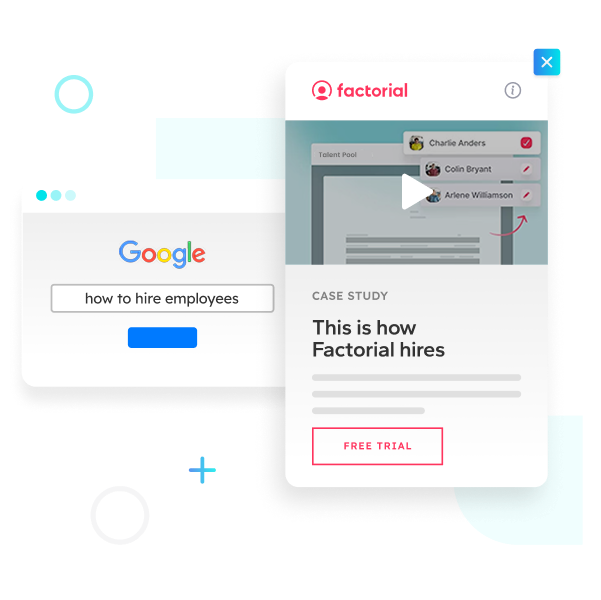
Why traditional digital marketing actions are not enough
When conversion rates are low, most marketing teams fall into one of two patterns.
The first reaction is to focus on traffic quality. More traffic, better traffic, new channels, better targeting. The assumption is simple: if the right people land on the site, conversions will improve. This leads to changes in keywords, campaigns, audiences, or content, often without questioning what happens once users arrive.
The second approach focuses on website conversion optimization. Teams keep traffic as it is and try to make the website perform better. They adjust copy, layouts, CTAs, forms, and run A/B tests to improve the overall conversion rate.
Both approaches make sense on their own. Both can produce results. The problem is that they are usually applied in isolation.
Traffic acquisition treats the website as a fixed destination. CRO treats traffic as a fixed input. In both cases, the website experience stays static, while visitors with very different intent levels are pushed through the same messages and the same conversion paths.
This is why it becomes hard to understand why visitors don’t convert. If conversions are low, teams don’t know whether they should improve traffic quality or keep optimizing the website. Metrics point in different directions, and decisions end up being driven by assumptions rather than clear signals.
Traditional digital marketing actions optimize individual parts of the funnel. What they fail to address is the gap between who is visiting and what the website expects them to do. That gap is where most conversion problems actually live.
Connecting traffic quality and website performance with Pathmonk’s intent-based personalization
Pathmonk is built around a simple idea: traffic quality and website performance shouldn’t be analyzed separately. What matters is how well the website responds to the intent behind each visit.
Instead of assuming that all visitors should see the same experience, Pathmonk looks at real-time intent signals. These signals come from how users arrive, what they interact with, and how they move through the site. Not just the channel, but the behavior. This allows Pathmonk to understand whether a visitor is exploring, comparing, or ready to take action.
Once intent is identified, the website experience adapts automatically.
High-intent visitors don’t need long explanations or generic reassurance. They need clarity, proof, and a clear path to conversion. Lower-intent visitors, on the other hand, need context, guidance, and time. Pathmonk adjusts what the website shows based on that difference, without forcing teams to manually define complex rules or build separate journeys.
This is what removes the guesswork between traffic quality and website optimization.
When conversions are low, the question is no longer “is the traffic bad or is the website broken?” Pathmonk makes that distinction visible by aligning the experience with intent. If high-intent visitors still don’t convert, the issue is likely in the message or the conversion flow. If low-intent visitors engage but don’t convert, that’s expected behavior, not a failure.
By connecting visitor intent with website performance, Pathmonk shifts optimization away from averages and toward relevance. Instead of optimizing one static experience for everyone, the website responds to who is actually visiting and what they are ready to do.
That’s the difference between guessing where the problem is and being able to see it clearly.
Increase +180% conversions from your website with AI
Get more conversions from your existing traffic by delivering personalized experiences in real time.
- Adapt your website to each visitor’s intent automatically
- Increase conversions without redesigns or dev work
- Turn anonymous traffic into revenue at scale

How Pathmonk increased +44% purchases for Print & Cheques Now with intent-based guidance
Print & Cheques Now Inc. used Pathmonk to respond differently to visitors based on real-time intent, while keeping the buying journey simple and consistent.
Pathmonk first analyzed how visitors behaved on the site to understand whether they were exploring, evaluating options, or close to purchasing. Based on that intent, the website showed different microexperiences before asking users to take action.
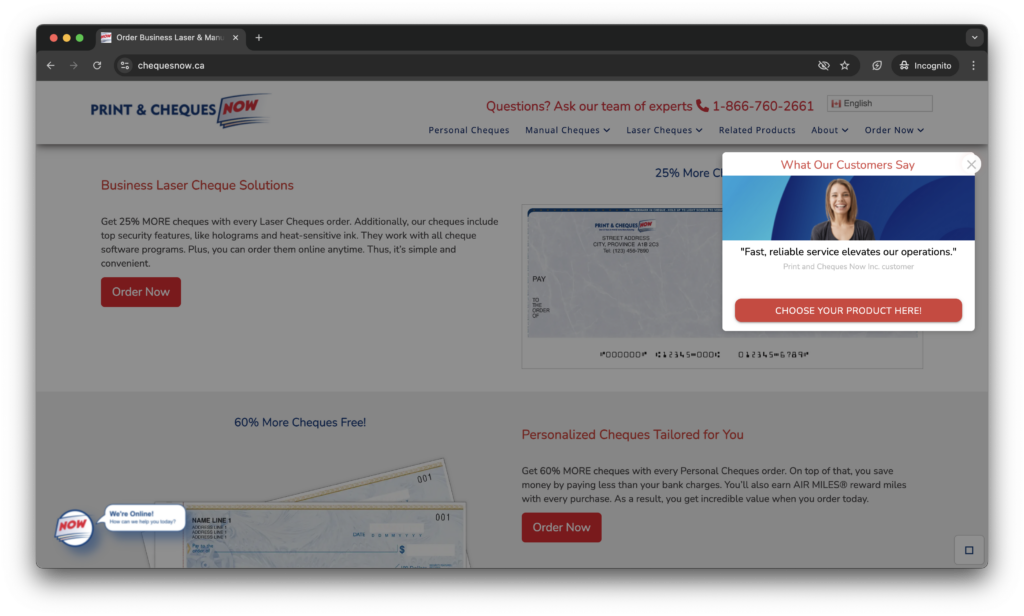
Visitors showing early or uncertain behavior were shown short videos and explanatory prompts to provide context and reduce confusion. Visitors with stronger buying signals were shown testimonials and trust cues to reinforce confidence and remove hesitation. In both cases, the experience adapted automatically based on behavior, not predefined rules.
Regardless of intent, every microexperience led to the same next step: the product selection flow. By adjusting what visitors saw before the decision, while keeping where they went next consistent, Pathmonk helped Print & Cheques Now improve relevance without fragmenting the journey.
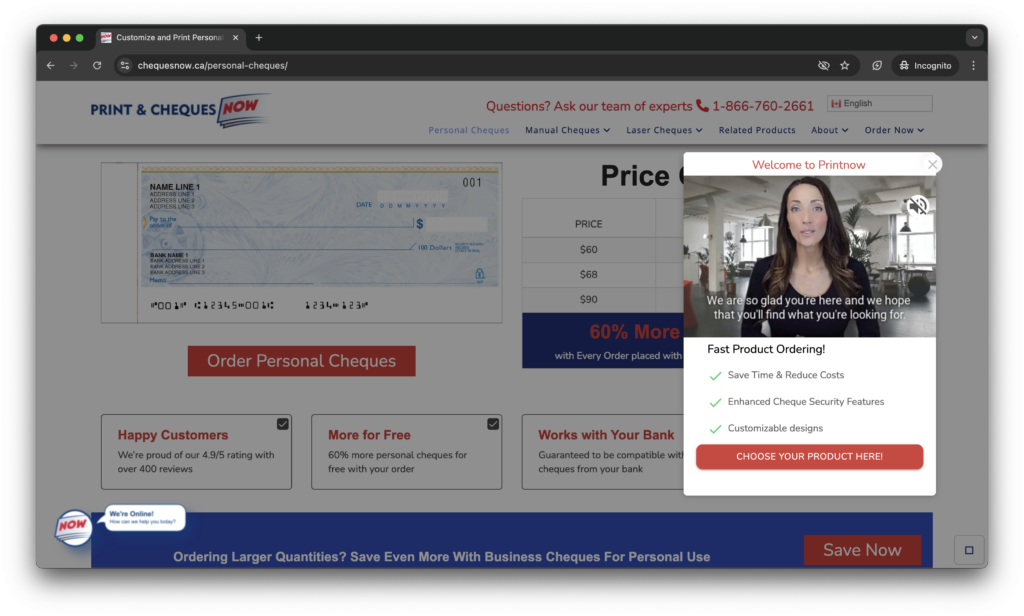
This intent-based approach allowed the website to guide different types of traffic more effectively, resulting in a 44% increase in conversions, without redesigning pages or changing traffic sources.
FAQs about traffic quality vs website optimization
How can I tell if low conversions are caused by traffic quality or my website?
Start by looking at behavior, not just conversion rate. If visitors engage, scroll, and explore but don’t convert, the issue is usually the website experience. If visitors leave quickly with little interaction, traffic quality or intent mismatch is more likely the problem.
Is it better to improve traffic quality or focus on website optimization first?
Neither should be treated in isolation. Improving traffic without adapting the website leads to missed opportunities, while optimizing the website without considering intent leads to misleading results. The goal is to align the website experience with the intent behind each visit.
Can good traffic still convert poorly?
Yes. High-intent visitors can fail to convert if the website shows generic messaging or asks for the wrong action at the wrong time. Good traffic still needs an experience that matches its level of readiness.
Can a well-optimized website compensate for low-quality traffic?
No. A strong website can guide and educate visitors, but it cannot create intent that isn’t there. Low-intent traffic should be handled differently, not forced into conversion paths meant for ready-to-buy users.
Why do conversion rates look low even when campaigns perform well?
Global conversion rates often mix traffic with very different intent levels. Awareness and educational traffic can lower the overall number, even if high-intent segments are converting efficiently. Segmenting by intent provides a clearer picture.
Why do traditional analytics make this hard to diagnose?
Analytics show what users do, but not why they do it. Without understanding intent, it’s difficult to know whether low conversions are due to traffic quality or a misaligned website experience.
Key takeaways
- A low conversion rate is a symptom, not a diagnosis. On its own, it doesn’t tell you whether the problem is traffic quality or the website experience.
- Traffic quality and website optimization can’t be evaluated separately. What matters is how well the website responds to the intent behind each visit.
- Good traffic can still fail on a generic website, and a strong website can’t compensate for low-intent traffic. Misalignment is usually the real issue.
- Traditional digital marketing and CRO actions optimize in isolation. They improve pages or traffic, but don’t explain why visitors don’t convert.
- Segmenting by intent, not just by channel or volume, is what makes conversion problems visible and actionable.
- Adapting the website experience based on real-time intent removes the guesswork between traffic and website issues and leads to more reliable improvements.