
You can generate significantly more leads from existing website traffic by systematically addressing conversion inefficiency rather than increasing traffic volume. The core levers are: behavioral intent detection at the session level, adaptive on-site experiences that match content to buyer stage, friction reduction in lead capture flows, and continuous experimentation on the highest-drop segments of your funnel. Most B2B websites convert between 1% and 3% of organic visitors. Closing half that gap through on-site optimization typically produces a 40% to 80% improvement in leads without any additional ad spend.
The mechanism is straightforward: most traffic acquisition budgets fund visitors who are already qualified enough to convert but encounter either the wrong message at the wrong moment, a form that demands too much too early, or a page that doesn’t reflect where they are in the decision process. Fixing these structural issues produces compounding returns because every improvement applies to all future traffic, not just a single campaign.
Table of Contents
Paid media has a structural problem that becomes more visible at scale: the cost of acquiring a click keeps rising while the percentage of those clicks that actually convert into leads stays roughly flat or declines. Paid lead generation consistently brings volume but not qualified buyers, and for most B2B companies, the conversion rate from paid traffic hovers between 2% and 4%, which means 96% to 98% of the budget is spent reaching people who leave without taking action.
The shift toward first-party data, the deprecation of third-party cookies, and the increasing cost of digital advertising have forced a strategic reallocation. Website conversion efficiency has become the lever with the highest marginal return in most B2B marketing programs, particularly when organic traffic is already generating consistent volume. The ROI case for conversion rate optimization is well-established: unlike paid acquisition, every improvement to on-site conversion applies to all future traffic permanently.
What’s changed technically is meaningful. Behavioral analytics have become granular enough to identify intent signals at the session level, not just at the visit aggregate. AI-driven personalization has dropped from enterprise-only to accessible for mid-market teams. And on-site experimentation tooling has matured to a point where running continuous, statistically valid tests doesn’t require a dedicated engineering team.
What most marketers still misunderstand is the difference between traffic-volume thinking and conversion-efficiency thinking. Traffic-volume thinking frames the lead generation problem as a reach problem: more impressions, more clicks, more top-of-funnel volume. Conversion-efficiency thinking frames it as a yield problem: a given volume of qualified traffic is already present, and the goal is to extract more leads from it.
This article covers the technical mechanisms behind a 60%+ organic lead generation increase, including behavioral intent layering, adaptive content serving, lead capture design, funnel analytics, and the infrastructure required to run experiments at scale.
Turn website traffic into sales-ready leads
- Identify high-intent visitors automatically
- Qualify leads before they reach your sales team
- Convert traffic without adding friction or forms
Why most websites underperform their traffic potential
The baseline problem: misalignment between intent stage and content served
A visitor landing on a B2B website from an organic search query arrives with a specific intent state. That intent state exists on a spectrum from general awareness through active consideration to near-decision. The problem is that most websites serve a static experience to all visitors regardless of where they sit on that spectrum.
A prospect at the decision stage who lands on a product feature page and encounters top-of-funnel educational copy is experiencing a mismatch. The reverse is also true: a visitor in the awareness stage who immediately receives a “Book a Demo” CTA before establishing any product context is unlikely to convert. Both scenarios produce exits that look identical in standard analytics but have completely different causes.
The standard analytics problem compounds this: pageviews, bounce rate, and even time-on-page fail to capture intent stage or the reason for an exit. Whether your conversion rate problem is rooted in traffic quality or your website experience is a diagnostic question most teams haven’t answered rigorously. You can see that visitors leave a pricing page at a 70% exit rate, but the data doesn’t tell you whether they left because the price was too high, because they weren’t ready to evaluate pricing yet, or because the page didn’t answer their comparison questions.
The lead capture friction inventory
Most lead forms are designed with internal needs in mind, not prospect behavior. The fields that exist in a form often reflect what the CRM requires, what sales wants to know before a call, or what a marketing automation platform needs to segment. The prospect’s experience is secondary.
Common friction patterns that suppress lead conversion:
- Premature qualification fields — asking for company size, budget range, or use case before the prospect has consumed enough content to have formed an opinion
- Form-to-value mismatch — gating high-value content (guides, benchmarks, tools) behind form fields that are disproportionate to the perceived value of the asset
- Single CTA architecture — offering only one conversion path (typically “Book a Demo”) to visitors at different stages, most of whom aren’t ready for that commitment
- Mobile form degradation — desktop-optimized forms that are technically functional on mobile but create excessive friction through small tap targets, keyboard interruptions, and vertical scroll requirements
- Missing trust signals at conversion points — no social proof, no clear description of what happens after the form is submitted, no privacy context
Get your website’s conversion score in minutes
- Instant CRO performance score
- Friction and intent issues detected automatically
- Free report with clear next steps
Traffic composition and conversion rate contamination
Organic traffic is not homogeneous. A website receiving 50,000 monthly organic sessions may have highly variable intent quality across those sessions depending on keyword intent, source, device, geography, and session depth. Applying a single conversion rate to aggregate traffic obscures the fact that some segments are converting at 8% while others are at 0.4%.
Segmenting conversion rate by traffic source, landing page type, keyword intent bucket, and device is a prerequisite for identifying where optimization effort produces the highest return. Without this segmentation, teams make optimization decisions based on averages that don’t represent any real cohort of visitors.
The five mechanisms for significant lead volume increase
1. Behavioral intent scoring at the session level
The most direct route to higher lead conversion is identifying which sessions have the highest conversion probability in real time, then triggering differentiated experiences for those sessions. Behavioral data at this level of granularity is what separates session-level optimization from page-level guesswork.
Behavioral signals that correlate with purchase intent:
- Scroll depth on product and pricing pages
- Return visit frequency and recency
- Navigation path from content to commercial pages
- Time spent on comparison-relevant pages (pricing, features, integrations)
- Engagement with social proof elements (case studies, testimonials, customer logos)
- CTA hover behavior and form field interaction without submission
The operational implication is that a visitor who has viewed the pricing page twice, scrolled to 80% depth on a product comparison guide, and spent over 4 minutes on the site is fundamentally different from a new visitor who arrived on a blog post and is still in the awareness stage. Both may appear on the same analytics dashboard as “sessions,” but they warrant completely different experiences.

Predictive lead scoring at the session level allows the website to surface high-intent CTAs only when behavioral thresholds are met, reducing the noise-to-signal ratio in demo requests and inbound inquiry quality simultaneously.
2. Stage-matched content and CTA architecture
A multi-stage CTA architecture serves different conversion offers based on where the visitor is in their buying journey. Most visitors who don’t book a call aren’t disqualified — they’re just not ready yet, and the right architecture captures them at an earlier stage rather than losing them entirely. The underlying logic is that the most effective action depends on the prospect’s readiness, and offering a lower-commitment conversion option to a visitor who isn’t ready for a demo still captures a lead that can be nurtured.
A three-stage CTA architecture for B2B:
Buyer stage | Appropriate conversion action | Example CTA |
Content asset, newsletter, tool | “Download the benchmark report” | |
Product walkthrough, comparison guide, case study | “See how it works for [use case]” | |
Decision | Demo, trial, pricing conversation | “Book a 20-minute demo” |
The mistake most teams make is forcing all visitors toward the decision-stage CTA regardless of behavioral context. This optimizes for the small minority of high-intent visitors while ignoring the larger majority who could be converted to a lead at an earlier stage and nurtured forward.
Implementation approach: Map current CTAs on all pages against the typical buyer stage of visitors who land on those pages. Identify pages where the mismatch is largest and test stage-appropriate alternatives. For most B2B sites, this produces measurable lift within two to three testing cycles.
high-ask CTA
high-ask CTA
low-ask CTA
low-ask CTA
3. On-site personalization based on visitor segments
Website personalization drives higher sales precisely because it resolves the static-experience problem at scale. In this context, personalization means dynamically adjusting page content, CTAs, or messaging based on visitor attributes and behavior — not just showing different ads to different audiences.
The most impactful personalization dimensions for B2B lead generation:
- Industry or company type — when identifiable through IP-based company enrichment or UTM parameters from segmented campaigns, showing industry-specific social proof or use case language
- Traffic source — visitors from organic search on product comparison queries behave differently from direct traffic; the page experience can reflect this
- Session stage in the funnel — first visit to a top-of-funnel post versus fifth visit on pricing page warrants different messaging and CTAs
- Prior content consumption — a visitor who has read three articles on one topic is signaling category interest that can inform what content or offer to surface next
Technical implementation options range from JavaScript-based content injection (feasible without developer involvement using modern tools) to server-side rendering for larger sites. The key requirement is a data layer that captures behavioral signals in the session and a rules engine that maps those signals to content variants.
The personalization that drives the most lead volume is not the most technically complex. Changing the headline on a key landing page to match the referral source, or surfacing a relevant case study to a visitor from a specific industry, frequently outperforms more elaborate personalization strategies.
4. Lead capture optimization: forms, flows, and friction reduction
The structure of a lead form is one of the highest-leverage variables in organic lead generation. Changes here apply to all organic traffic and require no incremental acquisition spend.
Form field reduction testing: The question of how to balance simplifying your funnel against adding qualification steps in forms is one of the most common in conversion work — and the research is consistent. Reducing fields from seven to three typically increases submission rate by 50% or more. The critical test is whether field reduction changes lead quality, which requires connecting form submissions to downstream sales outcomes and comparing conversion-to-pipeline rates by form variant.
Progressive profiling: Rather than requiring all information upfront, capture email and minimal identifiers in the initial conversion, then gather additional data points across subsequent sessions or in post-submission onboarding flows. This reduces initial friction while maintaining data completeness at the account level over time.
Micro-conversion sequences: The foot-in-the-door principle is well-supported in conversion research: instead of a binary “fill this form or leave” architecture, design multi-step flows where each step is a small commitment. A three-step form (step 1: enter email; step 2: confirm company; step 3: schedule call) consistently outperforms equivalent single-step forms because the commitment escalates gradually and early steps reduce abandonment psychology.
Placement and trigger logic: Forms and lead capture mechanisms that appear based on behavioral triggers (scroll depth reached, time-on-page threshold, exit intent signal) outperform fixed-position static forms. The behavioral trigger ensures the prompt appears when the visitor has demonstrated sufficient engagement to warrant the interruption.
5. Funnel analytics and iterative experimentation
Significant, durable lead generation improvements require a testing infrastructure, not a one-time optimization. CRO testing done correctly is a compounding activity — each locked-in gain raises the baseline from which the next experiment operates.
Funnel segmentation before testing: Before running any experiment, build a segmented view of the conversion funnel that shows conversion rates by traffic source, landing page, device type, and buyer stage proxy. This identifies which segment has the largest gap between current conversion rate and potential.
Experiment prioritization framework:
- Reach: what percentage of organic sessions are affected by this test
- Impact: if the hypothesis is correct, what’s the magnitude of improvement
- Confidence: how well-supported is the hypothesis by existing behavioral data
Tests with high reach and medium impact consistently outperform high-impact tests on low-traffic pages. A 10% improvement on a page receiving 30,000 sessions per month produces more leads than a 40% improvement on a page receiving 2,000 sessions per month.
Statistical validity requirements: Running tests without reaching statistical significance produces false learnings that can harm conversion rates when misapplied. A 95% confidence threshold before acting on test results is standard. For high-traffic pages, this is achievable in two to four weeks. For lower-traffic pages, either extend the test duration or pool data across similar page types.
Common testing mistakes that prevent scale:
- Testing too many variables simultaneously (multivariate tests require exponentially more traffic to reach significance)
- Running tests during atypical traffic periods (major campaigns, seasonal spikes) without controlling for the effect
- Ending tests early when early results look positive (winner’s curse effect in short tests)
- Not maintaining a control group to measure long-term drift
How behavioral segmentation changes lead quality, not just volume
A common objection to conversion rate optimization is that increasing submission rate will decrease lead quality. This is sometimes true when the optimization focus is purely on removing friction without any intent qualification. A “Name + Email” form with a low-value incentive can produce high submission volume with poor downstream conversion.
The resolution is to design lead capture around behavioral qualification rather than form-field qualification. A visitor who has spent 12 minutes on the site, read three product-related articles, and clicked through to the pricing page before seeing a lead form is behaviorally qualified regardless of whether the form asks for their company revenue. A visitor who abandons after 40 seconds and submits a form only because an intrusive pop-up appeared is form-field qualified but behaviorally unqualified.
Connecting lead quality to acquisition channel and on-site behavior — and using that data to weight experimentation toward high-quality-lead segments — is the approach that produces both volume and quality gains simultaneously. It requires connecting web analytics, CRM opportunity data, and closed-won/lost outcomes, which most teams have not done at a granular level.
Technical prerequisites for a high-performance lead generation system
Before attempting to implement the mechanisms above, verify that the following data infrastructure is in place:
- Session-level analytics with behavioral event tracking: Standard pageview analytics is insufficient. You need scroll depth events, click events on CTAs and navigation elements, form interaction events (field focus, field abandonment, submission), and time-based engagement events. Google Analytics 4 with properly configured event tracking or a dedicated product analytics tool (Mixpanel, Heap, Amplitude) provides this.
- Form submission attribution: Every lead form submission must be attributed to the landing page, traffic source, campaign (if paid), and device. If your CRM doesn’t receive this data automatically through UTM parameter capture, you’re optimizing blind.
- A/B testing infrastructure with proper traffic allocation: Most CMS platforms have basic A/B testing capabilities. For sophisticated behavioral targeting, a dedicated experimentation tool is required. The minimum viable requirement is the ability to allocate traffic by percentage, run tests simultaneously, and report statistical significance.
- CRM pipeline integration: Without connecting lead source data to pipeline stage and opportunity outcome, you cannot measure lead quality by acquisition channel or page variant. This connection is required for any quality-adjusted optimization.
How Pathmonk increases your leads without extra PPC budget
The traffic is already there. The problem is that most of it leaves without converting because every visitor sees the same static page, regardless of where they are in the buying process. Pathmonk works on that gap directly: it reads behavioral signals in real time, determines where each visitor sits in their journey, and serves a personalized experience designed to move them to the next step. No additional spend, no more traffic required. Just more leads extracted from the volume you already have.
The mechanism starts with intent classification. Pathmonk’s AI model reads each session as it happens, processing navigation path, pages visited, scroll depth, return frequency, and engagement with commercial content, then assigns the visitor to an awareness, consideration, or decision stage. That classification updates continuously as the session progresses. A visitor who lands on a blog post and then navigates to the pricing page is reclassified in real time.
Once intent stage is determined, Pathmonk triggers what it calls a microexperience: a lightweight, contextually matched prompt that asks for exactly the right level of commitment at that moment. An awareness-stage visitor gets a content offer or low-friction lead magnet. A consideration-stage visitor gets a case study or product walkthrough. A decision-stage visitor gets a demo or trial CTA. The result is that the same 10,000 monthly sessions that previously saw a single generic “Book a Demo” button now encounter an offer calibrated to where they actually are, and convert at a meaningfully higher rate across all three stages.
The system self-optimizes continuously. Pathmonk runs A/B tests on microexperience variants in the background, shifting traffic allocation once a 95% confidence threshold is reached. There is no manual experiment setup cycle. The platform locks in gains automatically and raises the baseline from which the next round of optimization starts.
Real-time personalization in a cookieless environment is another practical advantage. Pathmonk uses deterministic fingerprinting rather than third-party cookies, which means personalization applies to 100% of sessions rather than the 40 to 60% of EU visitors who accept consent banners. For B2B sites, a company-level identification add-on also surfaces which accounts are actively researching even when no form has been submitted, creating an additional lead layer from traffic that would otherwise leave no trace.
For marketers running paid campaigns alongside organic, this is where Pathmonk compounds the value of existing PPC investment. Every click from Google Ads, LinkedIn, or Meta that lands on a page covered by Pathmonk now benefits from the same intent-based personalization. The cost per lead from paid traffic drops because the post-click conversion rate improves, not because bid strategies change. A campaign that was generating leads at $120 CPL with a 2.5% landing page conversion rate produces the same lead at a materially lower cost when that conversion rate moves to 4% or 5%, with no change to spend. CRO directly lowers your CPL and CPA across every paid channel simultaneously. For demand gen and growth marketers managing mixed budgets, this means the same total spend produces more pipeline, or the same pipeline target becomes achievable at lower spend, freeing budget for acquisition scaling rather than plugging a conversion leak.
Installation is a single SDK snippet, compatible with WordPress, Shopify, and custom builds, with no engineering work beyond the initial tag.
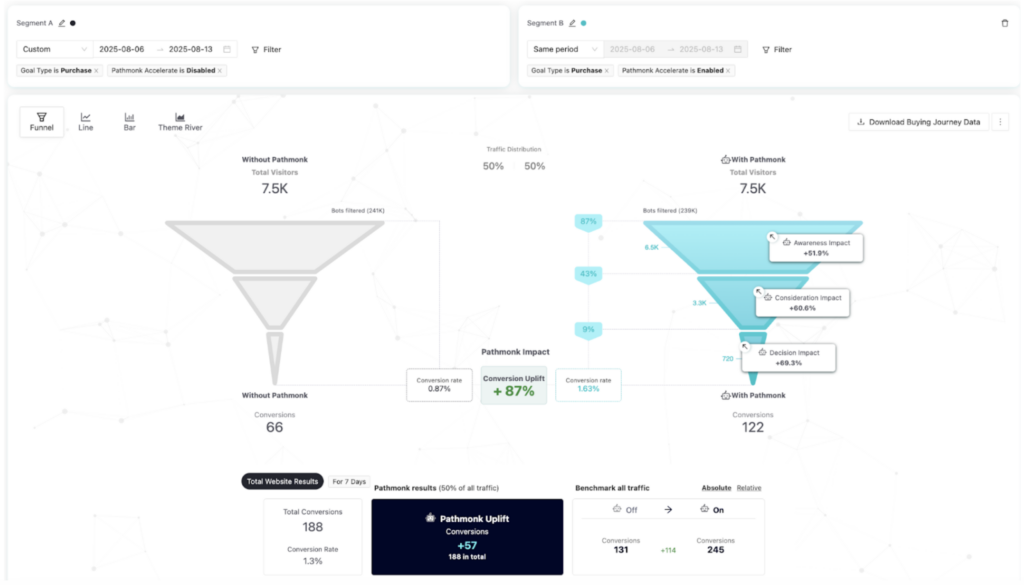
How Ausbildung-Weiterbildung.ch increased qualified registrations by 87% without increasing paid spend
Ausbildung-Weiterbildung.ch is one of Switzerland’s leading portals for vocational training and continuing education, operating in a highly competitive, SEO-driven market. The business model is organic-first by design: paid acquisition plays a secondary role, so the growth lever is always on-site conversion efficiency. The problem the marketing team faced was a gap that most high-traffic sites recognize but rarely quantify: the site was generating strong visitor volume but not extracting anywhere near its potential in qualified registrations.
The core issue was structural, not a traffic quality problem. Ausbildung-Weiterbildung.ch attracts two meaningfully different visitor types from organic search. The first is an early-stage candidate: someone searching broadly for “how to find an apprenticeship in Switzerland” or “what continuing education options exist,” typically at the awareness stage with no specific employer or program in mind. The second is a decision-ready candidate: someone searching for a specific course, a specific field, or a specific canton, actively comparing options and ready to register. Both segments were landing on the same pages and encountering the same generic registration CTA. The awareness-stage visitor, who wasn’t ready to commit, exited. The decision-ready visitor converted. The middle majority, by far the largest segment, received no experience calibrated to where they were, and largely bounced.
After deploying Pathmonk, the AI model began processing behavioral signals across sessions in real time: search query intent proxied through navigation path, scroll depth on program listing pages, return visit frequency, and engagement with employer profiles.

Visitors were classified into intent stages continuously, and microexperiences were triggered accordingly. Early-stage visitors received lower-commitment prompts oriented around content and search tools, reducing the barrier to a first conversion event. Decision-stage visitors received direct registration prompts at the moment behavioral signals peaked. No change was made to the traffic acquisition strategy, the page design, or the existing content.
The result was an 87% increase in qualified registrations within the first week. The speed of the gain reflects the size of the pre-existing gap: a large share of the traffic was already qualified enough to convert, but the flat on-site experience was failing to serve them the right prompt at the right moment. Ad spend was untouched throughout. The entire improvement came from converting a higher proportion of the organic traffic already on the site.
FAQ on AI-powered lead generation
What conversion rate improvement is realistic from on-site optimization without paid ads?
For most B2B sites currently converting at 1% to 3% of organic sessions, a 30% to 80% improvement in lead volume is achievable through systematic conversion optimization over six to twelve months. The range depends on how underoptimized the baseline is, the quality of behavioral data available, and the pace of experimentation. Sites with severe structural friction (long forms, single CTA architecture, no stage matching) tend to see faster initial gains.
Does increasing on-site conversion rate reduce lead quality?
It can, if the optimization focuses exclusively on friction removal without any behavioral qualification layer. The risk is minimized by combining form simplification with behavioral intent signals — only surfacing high-commitment CTAs to visitors who have demonstrated sufficient session engagement. Connecting downstream pipeline data to lead source segments allows you to measure quality-adjusted conversion rate rather than raw submission volume.
How does cookieless personalization differ from standard cookie-based personalization in terms of capability?
The main practical difference is coverage. Cookie-based personalization is limited to visitors who have accepted a consent banner (typically 40% to 60% of EU traffic) and whose cookies are intact across sessions. Cookieless approaches using device fingerprinting or deterministic identifiers can cover a higher percentage of sessions, including returning visitors who cleared cookies. The behavioral signal richness is comparable for session-level personalization; where cookies have an advantage is in long-term cross-session identity resolution.
Should lead capture optimization be prioritized before or after landing page content optimization?
Typically landing page content first, lead capture form second. If the page is not communicating the value proposition clearly to the target segment, form optimization will have limited effect. A well-matched page with a suboptimal form outperforms a poor page with an optimized form. The sequence should be: segment, diagnose drop-off stage, optimize the content layer, then optimize the capture mechanism.
How do you measure the incremental lead value of on-site optimization versus organic traffic growth?
Hold organic traffic volume constant as a control variable and track lead volume alongside it. If organic sessions increase 10% and lead volume increases 30%, the incremental 20% is attributable to on-site optimization. More precisely, you can track leads per 1,000 organic sessions as the primary KPI, which normalizes for traffic volume changes and isolates conversion efficiency.
What’s the relationship between page load speed and lead conversion rate?
The relationship is well-documented: each one-second increase in page load time reduces conversion rate by approximately 4% to 7% for B2B sites, with stronger effects on mobile. For sites with significant organic mobile traffic, Core Web Vitals optimization is a conversion activity, not just a technical SEO activity. LCP (Largest Contentful Paint) above 2.5 seconds correlates with measurable conversion suppression.
How do multi-touch attribution models affect how you measure the contribution of on-site optimization?
Standard last-click attribution undervalues on-site optimization because it attributes lead conversion to the acquisition channel rather than the on-site experience. A time-decay or data-driven attribution model better represents the contribution of on-site conversion elements. Practically, the cleanest way to measure it is through controlled experiments where the on-site experience is the test variable and traffic mix is held constant.
Increase +180% conversions from your website with AI
Get more conversions from your existing traffic by delivering personalized experiences in real time.
- Adapt your website to each visitor’s intent automatically
- Increase conversions without redesigns or dev work
- Turn anonymous traffic into revenue at scale

Key takeaways
- Most B2B websites convert 1% to 3% of organic traffic; closing half that gap through on-site optimization is a realistic objective with current tooling
- The primary cause of conversion underperformance is misalignment between visitor intent stage and the content and CTAs served to them
- Behavioral signals at the session level (navigation path, scroll depth, return frequency, engagement with commercial pages) are more predictive of conversion than demographic or firmographic data
- A multi-stage CTA architecture that offers stage-appropriate conversion actions to awareness, consideration, and decision visitors captures leads that a single-CTA approach misses entirely
- Form friction is a consistently underestimated suppressor; reducing field count and implementing progressive profiling produces measurable lift with no traffic-side changes
- Conversion rate optimization compounds: each gain applies to all future traffic, producing increasing returns over time
- Statistical rigor in experimentation is non-negotiable; tests ended early or run without significance thresholds produce false learnings that harm performance
- Lead quality and lead volume are not inherently in tension when behavioral qualification is part of the conversion architecture
- Cookieless tracking is now a practical requirement, not a future consideration, particularly for sites with significant EU organic traffic
- Connecting web behavioral data to downstream CRM pipeline outcomes is the only way to run quality-adjusted optimization