Cold traffic enters your website at the awareness stage: no prior brand exposure, no established need, no basis for trust. The tools that effectively nurture these visitors on-site share one mechanism: they detect the visitor’s journey stage in real time and adjust the experience accordingly, rather than serving a single static page to everyone regardless of intent.
The most effective on-site nurturing solutions fall into three categories: behavior-triggered personalization platforms that classify journey stage and serve stage-appropriate interactions, progressive content sequencing tools that reveal information in proportion to observed engagement, and guided qualification flows that move cold visitors from passive browsing into active consideration by structuring the discovery process. Each has distinct technical requirements, measurement approaches, and points of failure.
Table of Contents
A 2026 Forrester study found that 68% of B2B buyers research three or more vendors before engaging with sales, and most do this research anonymously, without identifying themselves to any of those vendors. What they encounter during that anonymous research phase determines whether they continue toward a product or disappear into a competitor’s funnel. For most websites, what they encounter is a single homepage or landing page, built for the 3-7% of visitors who arrive already knowing what they want.
This is the Cold Journey Gap: the structural mismatch between what awareness-stage traffic needs (progressive trust-building, contextual education, low-friction discovery) and what most conversion-optimized websites deliver (CTAs designed for audiences that already understand the value proposition). The gap is expensive. Paid media driving awareness-stage traffic into a bottom-funnel experience produces predictably low conversion rates, not because the traffic quality is wrong, but because the on-site experience doesn’t correspond to where that visitor actually sits in their decision process.
What has shifted in the past three years is the availability of real-time behavioral intelligence operating at the page level. Journey-stage detection, once confined to email nurturing sequences or CRM-based lead scoring, now operates on-site within a single session. That changes what’s possible: cold visitors can receive genuinely different experiences based on observed behavior (scroll depth, page sequence, time on section, click patterns) rather than assumed intent from traffic source alone.
This article maps the solution categories available for on-site cold traffic nurturing, the behavioral signals each one uses, where they succeed, and where they break down.
Turn website traffic into sales-ready leads
- Identify high-intent visitors automatically
- Qualify leads before they reach your sales team
- Convert traffic without adding friction or forms
What cold traffic actually looks like behaviorally
Before selecting a nurturing solution, the behavioral profile of cold traffic is worth being precise about. Cold visitors are not simply low-intent. They often have genuine purchase potential: they searched for a category, clicked a display ad, or found a blog post. But they lack the frame of reference to evaluate what they see.
On the website, cold visitors behave measurably differently from warm ones:
- Session depth is shallower. Warm visitors navigate directly to pricing or contact pages. Cold visitors explore vertically on a single page, then exit.
- Engagement is front-loaded. Attention spikes in the first 30 seconds, then drops off. If the first screen doesn’t answer “why should I care,” most cold visitors don’t scroll far enough to reach the content that would change their view.
- CTA interaction is low and late. On standard landing pages, cold visitors who do interact with CTAs take 3-4x longer to do so compared to visitors from branded search. They need more context before they’re willing to act.
- Return visit rates are higher than warm traffic assumes. Cold visitors in B2B categories return an average of 2.3 times before converting, per Demand Gen Report data. Most analytics tools attribute the conversion to the last session, making cold nurturing look less effective than it is.
Understanding why visitors don’t convert requires separating traffic quality from experience-stage mismatch. Cold traffic converting poorly on a warm-optimized experience is not evidence of bad traffic. It is evidence that the site lacks stage-appropriate experiences entirely.
The cold journey gap: why static sites fail awareness-stage visitors
The traditional website is a fixed experience. Every visitor sees the same headline, the same value proposition, the same call to action. That model made sense when web development was expensive and personalization required significant engineering. Neither is true anymore.
A static website forces cold visitors to self-qualify through a funnel designed for someone already at the decision stage. The friction compounds: cold visitors who don’t understand the product skip the pricing page (too early), ignore the “Book a Demo” CTA (too much commitment), and leave without providing any signal that would allow retargeting or follow-up.
The Cold Journey Gap creates three downstream effects:
- Paid media efficiency drops. Cold traffic from paid channels has inherently lower purchase intent than branded organic search. When that traffic lands on a static, conversion-optimized page, bounce rates are high, cost per lead rises, and demand gen teams conclude the channel doesn’t work. In most cases, the channel is fine. The landing experience is wrong for the audience.
- Organic content investment underperforms. Awareness-stage content strategies bring in large volumes of early-stage visitors. Without on-site nurturing, those visitors read one article and leave. The content creates no pipeline because there’s no on-site mechanism to move them forward from informational to commercial intent.
- Retargeting audiences are polluted. When cold visitors who haven’t been nurtured get retargeted with bottom-funnel ads (“Start your free trial”), the conversion rate on retargeting spend falls. The visitor wasn’t ready when they first visited; they haven’t become ready just because a week has passed.
The solution is not producing more content or spending more on retargeting. The customer journey optimization problem is an on-site one: the website needs to detect where a visitor is and serve an experience appropriate to that stage.
Journey-stage detection: the prerequisite for on-site nurturing
Every on-site nurturing solution depends on one underlying capability: classifying where a visitor is in their buying journey before serving them a differentiated experience. The accuracy of that classification determines whether personalization helps or annoys.
There are three approaches to journey-stage detection currently in use:
- Traffic source as a proxy for stage. The simplest approach. Visitors from branded search are treated as warm; visitors from display ads or social are treated as cold; visitors from organic content are treated as awareness-stage. This works as a rough heuristic but fails on multi-channel paths. A visitor who saw a branded ad, searched the brand two days later, and clicked an organic result is not cold, but source-based logic would misclassify them. Understanding the full picture requires proper customer journey mapping.
- Rule-based behavioral triggers. On-site tools configured to fire experiences based on specific conditions: time on page, scroll percentage, page count, exit intent. This is more accurate than source-based classification but requires significant configuration to maintain across a website and can produce false positives (a visitor spending 90 seconds on a page because they got distracted looks identical to one genuinely reading in-depth content).
- Real-time behavioral scoring. AI-based systems that process multiple behavioral signals simultaneously (page sequence, interaction patterns, session cadence, scroll velocity, repeat visit history) and produce a continuous estimate of journey stage and intent. This approach requires a data threshold (Pathmonk requires 10,000 pageviews per month to activate meaningful models) but produces substantially more accurate classifications. The behavioral signals behind stage detection move beyond isolated events toward pattern-level inference. This is also where intent data plays a structural role: the more signals the model ingests, the more reliable the stage assignment.
The practical implication: solutions built on traffic source proxies are fast to implement but plateau quickly. Rule-based systems produce more targeted experiences but accumulate technical debt. Behavioral scoring systems require more initial data but produce experiences that actually match what cold visitors need at each moment.
On-site nurturing mechanisms: what works for cold visitors
Behavior-triggered microexperiences
A microexperience is a small, contextual interaction that appears on top of the existing page content without interrupting the browsing session. At the awareness stage, well-designed microexperiences accomplish a specific job: reduce cognitive load by surfacing the single most relevant piece of information or next step for a visitor who is still orienting.
For cold traffic, effective microexperience objectives include:
- Educational offers: “Here’s a guide to [problem the visitor is researching]” trades immediate value for contact information or continued session depth
- Contextual navigation prompts: “Based on what you’re reading, you might want to see [specific use case or comparison]” reduces the self-navigation burden that causes cold visitors to exit
- Credibility anchors: Surfacing social proof or customer evidence at the moment a visitor hits a feature description they haven’t encountered before
What microexperiences for cold traffic must not do: demand commitment before establishing value. Showing a “Book a Demo” overlay to a visitor who has been on-site for 45 seconds and read one paragraph is premature, and conversion data consistently shows it reduces conversion rate relative to control. The goal at the awareness stage is moving the visitor to consideration, not skipping to decision-stage actions.
The best practices for creating high-converting microexperiences consistently point to one principle: match the commitment level of the interaction to the visitor’s demonstrated engagement level.
Progressive content sequencing
Progressive content sequencing is the practice of revealing different information layers based on observed engagement depth, rather than presenting all information simultaneously and hoping the visitor finds what they need.
In practice, this means a cold visitor who has spent fewer than 60 seconds on a page sees a simplified value proposition with social proof. A visitor who has scrolled 70% of the page and spent 3+ minutes sees a more detailed feature comparison or use case example. A visitor on their third page in the session sees a qualification-aware CTA or a “compare options” prompt.
Most CMS platforms and landing page builders cannot implement this natively without significant custom development. The tools that support progressive sequencing out of the box achieve it either through rule-based triggers or AI-driven stage classification. Hyper-personalization at this level is no longer reserved for enterprise teams with dedicated engineering resources.
The failure mode for progressive content sequencing is over-engineering. When teams build 12-state content trees for every possible behavioral path, maintenance cost exceeds the conversion lift. The segment that matters most for cold traffic is binary: visitors who are genuinely engaged versus those who are passively loading pages. Designing for that split, rather than attempting to account for every micro-variation, captures the majority of the available uplift.
Guided qualification flows
A qualification flow is an interactive on-site experience that guides visitors through a structured set of questions, then delivers a personalized outcome (a recommended solution, a relevant content piece, or a specific CTA) based on their responses.
For cold traffic, qualification flows serve a function that static pages cannot: they make the visitor feel that the website is responding to their specific situation rather than broadcasting to an assumed audience. The psychological mechanism at work is the foot-in-the-door technique: small commitments (answering one question) increase the likelihood of subsequent engagement (submitting a form, booking a call).
Qualification flows work best when they are:
- Short: 3-5 questions maximum. More than that and completion rates drop below 30%
- Outcome-specific: The end state must feel materially different based on responses. Flows that funnel everyone to the same CTA regardless of answers lose credibility immediately
- Low-friction at entry: The first question should be easy and non-personal (“What’s the primary challenge you’re trying to solve?”) rather than asking for contact information upfront
Where qualification flows fail is in the construction assumption: they assume visitors know enough about their own problem to answer structured questions about it. For visitors who are very early in an awareness stage, actively searching a category but not yet sure what they need, qualification flows can create friction instead of reducing it. What to do with visitors who aren’t ready to convert requires a different approach: lower-commitment pathways like content recommendations or newsletter opt-ins, not qualification loops that presuppose purchase intent.
Where most solutions fail cold traffic
Personalization platforms as a category have a well-documented gap between capability and execution. A 2024 Gartner analysis found that while 80% of organizations have invested in personalization tools, fewer than 25% report meaningful on-site personalization actually deployed at scale.
The gap is not technical. It comes from three structural problems:
- Warm traffic bias in optimization models. Most A/B testing frameworks optimize for the visitors who convert, which by definition skews toward warm audiences. Cold traffic is systematically underweighted in the data that drives experience decisions, so the resulting “optimized” experiences continue to be calibrated for warm visitors.
- Content production bottlenecks. Delivering different experiences for different journey stages requires different content. Most marketing teams build one set of creative assets per campaign, leaving personalization platforms with nothing to differentiate. The tool exists; the content library doesn’t. Efficient journey orchestration breaks this bottleneck by separating content creation from experience delivery, but most teams haven’t made that operational split.
- Measurement attribution failures. Cold traffic nurturing produces multi-touch conversion paths where the on-site nurturing interaction happens in session one and the conversion happens in session three or four. Last-click attribution shows the on-site nurturing producing zero conversions. Teams cut the investment. The actual impact on pipeline is invisible. The same misattribution problem applies to B2C touchpoint sequences, where a cold-session microexperience may precede a purchase by days or weeks.
Solving the cold traffic nurturing problem requires addressing all three: journey-stage-aware optimization models, content variants mapped to awareness / consideration / decision stages, and multi-touch measurement frameworks that credit session-one interactions for session-four conversions. The ROI of conversion rate optimization becomes legible only when attribution captures the full journey, not just the final click.
How Pathmonk nurtures cold traffic without changing your website
Pathmonk’s core mechanism for cold traffic is real-time journey stage classification combined with automated microexperience delivery matched to that classification. The system operates on top of the existing website without requiring changes to underlying page content or layout.
How the stage detection works: Pathmonk’s cookieless fingerprinting engine collects behavioral signals from the first moment a visitor lands: scroll velocity, interaction with specific page elements, navigation path, session cadence. Within a session, these signals feed into a classification model that assigns the visitor to one of three journey stages: Awareness, Consideration, or Decision. The model updates continuously as the visitor’s behavior reveals more information. A visitor who initially looks like a cold awareness-stage browser but suddenly navigates to the pricing page gets reclassified to Decision, and the microexperience served changes accordingly.
What cold visitors receive: At the Awareness stage, Pathmonk serves microexperiences focused on problem education and trust establishment: content offers, social proof prompts, use case introductions. The conversion goal embedded in these microexperiences is always the same primary action (booking a demo, starting a trial, requesting a quote), but the supporting content changes. A cold visitor sees the context that justifies clicking that CTA; a warm visitor sees the confirmation that removes final objections.
This is a critical accuracy point: Pathmonk changes the supporting content of the microexperience at each stage, not the conversion goal itself. The product does not declare a winner and automatically reroute all traffic. Once an organization has gathered 50/50 A/B test results at sufficient confidence and manually validates the data, they scale the winning experience to 95% of traffic exposure while maintaining a 5% control group.
The cold traffic specific advantage is that Pathmonk’s system does not require pre-configured rules for each cold traffic source. The behavioral model handles visitors from display advertising, organic content, social referral, and direct entry in a unified framework. The same installation detects stage across all of them, rather than requiring different configurations per channel. This matters because cold traffic from paid channels behaves differently than cold traffic from organic content even when both arrive at the same page, and the model reflects that without additional setup.
For B2B websites specifically, the B2B intent leads feature adds a layer: identifying the company behind an anonymous visit. A cold visitor from an enterprise whose company is in the target ICP can receive a distinct microexperience calibrated to enterprise purchase processes (longer consideration cycles, committee buying patterns, compliance-forward messaging) without manual segmentation. This brings account-based marketing intent signals directly into the on-site experience without requiring a separate ABM platform.
Pathmonk guarantees a minimum 20% conversion uplift, measured by a controlled A/B comparison, before full scaling. The guarantee holds across traffic types, including cold traffic from paid and organic sources. See how the 20% uplift guarantee works for the measurement methodology.
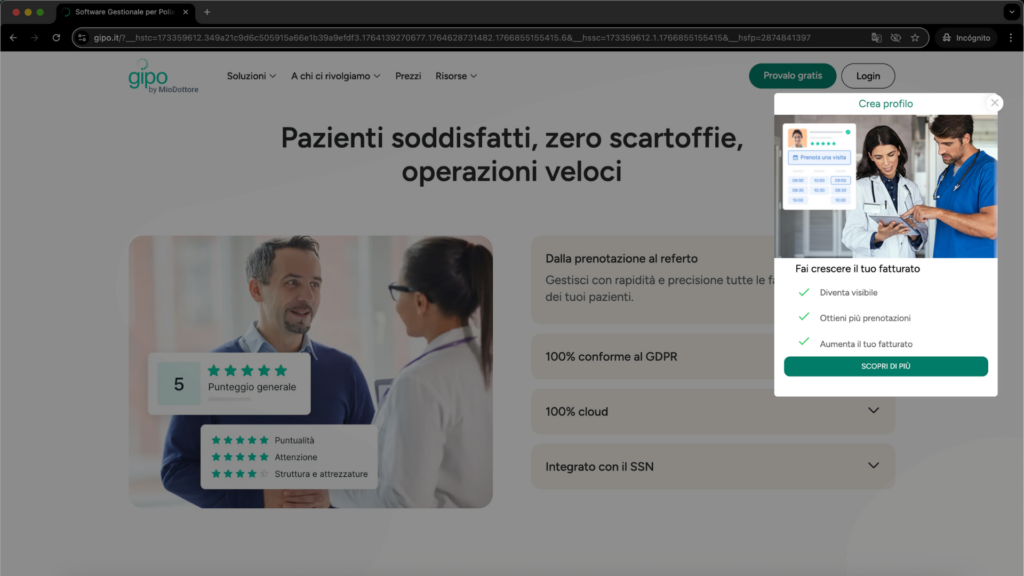
How Doctoralia converted cold visitors across three markets in two weeks
Doctoralia operates the largest healthcare appointment platform in Latin America and Europe, connecting patients to doctors across multiple countries. Their challenge was common but scaled: millions of visitors entering from general health searches, cold, anonymous, without any prior brand relationship, landing on a single static booking experience regardless of what they were searching for.
The structural problem was market heterogeneity. A visitor from Spain searching “dermatologist near me” has different trust thresholds, different social proof requirements, and different hesitation patterns than a visitor from Mexico or Colombia searching similar queries. A single on-site experience couldn’t address all three markets simultaneously.
- Cold visitors entering from organic health searches with no brand familiarity
- No mechanism to differentiate experience by market context or journey stage
- Static booking CTA performing inconsistently across Spain, Mexico, and Colombia
Pathmonk’s behavioral classification identified journey stage signals consistent across market boundaries: engagement depth, return visit patterns, interaction with specialty-specific page elements. Microexperience content varied by detected market context. Cold visitors in the early awareness stage received localized trust signals and social proof relevant to their market. Visitors who had already navigated to specialty-specific pages received more direct booking prompts.
- +82% average conversion uplift across three markets
- Results achieved in two weeks
- Zero changes made to underlying website pages
- Development team remained uninvolved throughout
The microexperience layer operated entirely on top of the existing site. The gain came from stage detection and market-aware content delivery, not from redesigning the product.
Increase +180% conversions from your website with AI
Get more conversions from your existing traffic by delivering personalized experiences in real time.
- Adapt your website to each visitor’s intent automatically
- Increase conversions without redesigns or dev work
- Turn anonymous traffic into revenue at scale
FAQ on nurturing cold traffic
What is the minimum traffic volume needed to run effective on-site cold traffic nurturing?
Behavioral scoring systems require sufficient data to produce statistically meaningful classifications. Pathmonk sets a threshold of 10,000 pageviews per month before activating personalization. Rule-based systems have no minimum but also produce no learning: they execute fixed triggers regardless of whether those triggers are accurate for the actual visitor population. Behavioral systems below the data threshold should fall back to rule-based approaches while accumulating the volume needed for model activation.
Does cold traffic nurturing conflict with lead qualification goals?
Only if the nurturing mechanism is misapplied. Cold traffic nurturing is not about lowering qualification standards. It is about moving visitors from awareness to consideration before asking them to self-identify. Qualification flows are a valid nurturing mechanism when deployed at the consideration stage, not the awareness stage. Triggering a qualification flow for a visitor who has been on-site for under 60 seconds produces poor completion rates and self-selects for the visitors least representative of actual purchase intent.
How do you measure the impact of on-site nurturing on cold traffic specifically?
The standard approach is session segmentation combined with multi-touch attribution. Segment visitors by traffic source and session number, then measure the difference in return visit rate and downstream conversion rate between the control group (static experience) and the personalized group. Last-click attribution will systematically undercount the impact of session-one nurturing, so the measurement window needs to extend across the full buying cycle: 14-30 days for B2C, 30-90 days for B2B.
Can on-site nurturing substitute for email nurturing sequences?
No. On-site and email nurturing address fundamentally different stages of the same problem. Email nurturing requires a contact record: it only applies after a visitor has converted on a micro-goal (subscribing, downloading, registering). On-site nurturing addresses the anonymous session before that happens. They are complementary: on-site nurturing converts more anonymous visitors into micro-conversion contacts, which email nurturing then takes through to pipeline.
What types of microexperiences are most effective for awareness-stage visitors?
Content offers with immediate value delivery outperform all other formats for cold traffic. A guide, checklist, or report offer relevant to the page topic produces higher opt-in rates than generic lead magnets. Overlay timing matters: experiences triggered at 60-70% scroll depth perform better than those triggered by time alone, because scroll depth is a stronger indicator of genuine engagement. Best practices for high-converting microexperiences consistently identify relevance of trigger context over offer value as the primary driver of completion.
How does cookieless personalization work for cold visitors?
Cookieless fingerprinting uses a combination of device characteristics, behavioral patterns, and probabilistic modeling to create a persistent visitor identifier without relying on browser cookies or requiring consent banners. For cold traffic specifically, this means Pathmonk can detect a returning cold visitor across sessions even when that visitor never logged in or provided contact information. That capability is essential for B2B buying journeys that typically span 6-12 sessions before conversion, and it becomes increasingly important as cookieless environments reshape personalization infrastructure.
Do qualification flows work for very early-stage cold traffic?
Qualification flows produce the best results for visitors in early consideration: they understand the category, are aware they have a problem, but haven’t evaluated specific solutions. For very early awareness (visitors who found a top-of-funnel content piece and have no commercial intent signal), qualification flows create friction. The better on-site mechanism at that stage is a lower-commitment interaction: a related content recommendation or a topic-specific newsletter opt-in. Lead nurturing strategies for early-awareness visitors prioritize capture over qualification.
What is the typical timeline to see conversion impact from cold traffic nurturing?
Conversion impact on cold traffic manifests in two waves. The first wave (higher engagement rates, lower bounce rates, more micro-conversions such as content downloads and guide opt-ins) is visible within 1-2 weeks of activation. The second wave (increased pipeline contribution from cold traffic sources) requires a full buying cycle to measure: 30-90 days for B2B categories. Organizations that measure only week-one direct conversion will understate the impact. The buying journey report provides visibility into the full session sequence that leads to conversion, making this measurement tractable.
Key takeaways
- The Cold Journey Gap is the mismatch between what awareness-stage visitors need and what conversion-optimized static websites deliver. It compounds the cost of both paid and organic traffic acquisition.
- Journey-stage detection is the prerequisite for all on-site nurturing. Traffic source is an unreliable proxy; rule-based triggers have limited scalability; behavioral scoring systems require a data threshold but produce the most accurate classifications.
- The three primary on-site nurturing mechanisms (microexperiences, progressive content sequencing, and qualification flows) serve different visitor states. Qualification flows are not appropriate for very early-stage cold visitors.
- Cold traffic nurturing works best when the conversion goal stays consistent (same CTA) while the supporting experience changes by stage. Changing the CTA by stage creates measurement complexity without proportional lift.
- Multi-touch attribution is required to measure cold traffic nurturing accurately. Last-click models attribute zero credit to session-one nurturing interactions that produce session-four conversions.
- The failure modes of personalization platforms are organizational, not technical: warm traffic bias in optimization models, content production bottlenecks, and attribution frameworks that make cold traffic nurturing look ineffective.
Pathmonk’s cookieless, real-time stage detection activates on-site nurturing without development resources, making cold traffic personalization accessible to teams without engineering support.